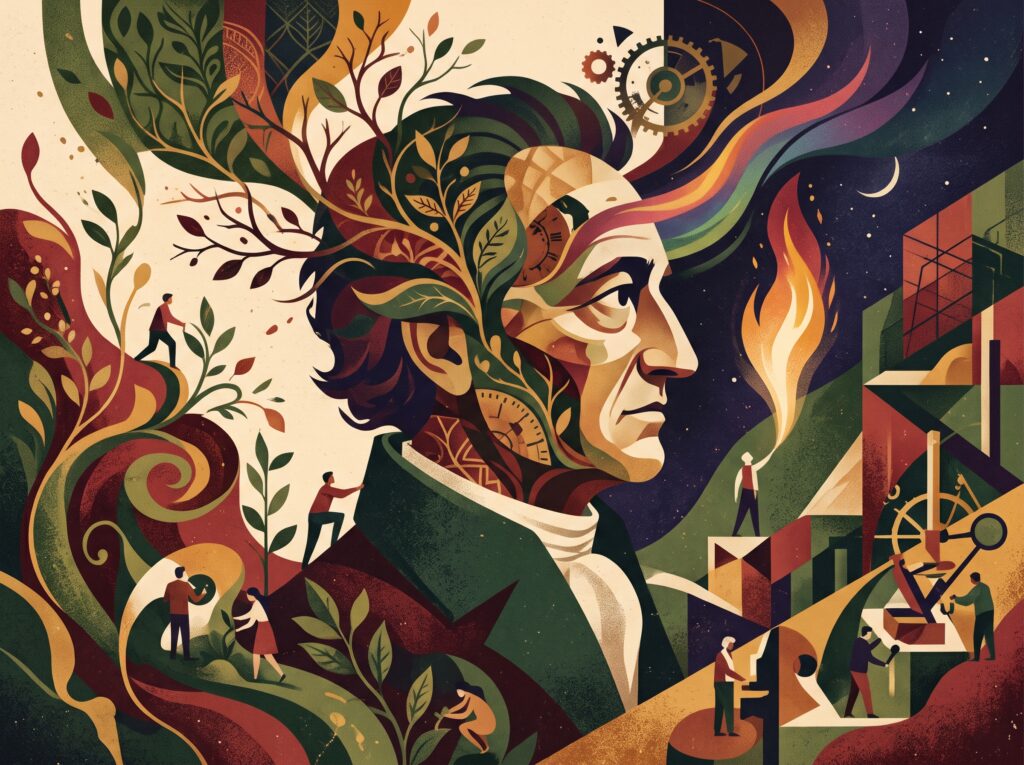
Why have humans become so predictable? Our behavior is dictated by our relentless, almost religious devotion to optimisation. Work and society over the last ten years has demanded that humans maximise efficiency, streamline our routines and curate our lives in favor of peak performance. This applies to both physical and cognitive loads.
Our worth is now measured in key performance indicators, quarterly returns, and productivity metrics. Instead of treating our co-workers as dynamic, living organisms, they have become assocaited with programmabel machines. No where is this more obvious then in the layoff announcements that many organisations are facing today. The more programmable workers have become the more likely they are to be discarded when the output can be replaced.
Beneath this hyper-efficient knowledge economy that many have leaned towards is a profound and silent epidemic of spiritual exhaustion. We are working harder than ever, yet a nagging sense of meaninglessness pervades the modern condition. We are left asking: what is the point?
A Renewed Process of Self-Cultivation
In the late eighteenth century, as the first gears of the Industrial Revolution began to grind and the Enlightenment threatened to reduce the cosmos to a clockwork mechanism, Johann Wolfgang von Goethe foresaw this exact crisis of spirituality. He watched with a growing sense of dread as the emerging industrial and scientific age began to carve up human experience into fragmented disciplines.
For Goethe, the answer to this impending alienation was not to retreat from the world, but to redefine our relationship to it. He offered a counter-framework, encapsulated in an interesting German concept: Bildung. Bildung is the lifelong, organic process of self-cultivation. It involves active, deliberate shaping of one’s own character, that treats the individual life as a dynamic work of art in progress. By connecting Goethe’s philosophy of Bildung to the modern world of work, we can find a potential antidote to the fragmentation of modern societies.
To understand Bildung, one should understand Goethe’s view of nature. His philosophy of human development was deeply rooted in his scientific observations. Goethe rejected the mechanistic view of the universe popularized by Isaac Newton. Newton saw the universe as a lifeless machine operating according to mathematical laws but Goethe saw a living organism pulsing with energy, what he called Gott-Natur.
In his botanical studies, Goethe coined the term morphology, the study of organic form. He hypothesized the existence of the Urpflanze, a primal plant from which all other plant forms adapt and derive. He observed that a plant unfolds from within, driven by a blueprint that interacts dynamically with the sunlight, soil, and water of its environment.
Goethe believed that human beings must develop in the same way. We are not empty vessels waiting to be filled with technical skills. Instead we are organic entities meant to unfold toward a state of harmonious complexity. Bildung is the sunlight and soil of this human unfolding. It is the process by which we encounter the friction of the external world and use that friction to expand our inner capacities. When we view our lives through the lens of Bildung, the primary question we ask of our work are more thoughtful: “Who am I becoming by doing this work? Is this labor expanding my soul, or is it withering my roots?” This stands in stark contrast to the dominant philosophy of labor that arose during Goethe’s lifetime.
Can there be a balance in production?
In 1776, Adam Smith published The Wealth of Nations, famously praising the division of labor in a pin factory. Smith observed that by breaking down the manufacture of a pin into eighteen distinct, repetitive tasks, production skyrocketed.
Economically, it was a triumph. Psychologically, it was a catastrophe. Goethe recognized that if a human being spends their entire waking life hammering the head of a pin, they eventually become the head of a pin. Their mind narrows to the circumference of their task. The wholeness of the individual is sacrificed on the altar of output.
Today, this division of labor has infiltrated the realm of intellectual and creative work. The modern corporate structure demands the worker who knows an extraordinary amount about an increasingly microscopic domain. We are pressured to own the niche, to brand ourselves, to become the definitive expert in one narrow sliver of the market.
Goethe warned against this trajectory. He believed that to be a fully realized human requires cultivating a balance of intellect, emotion, and experience. He coined the term Fachidiot aka the subject idiot, or the narrow-minded specialist who is brilliant in their specific field but utterly blind to the broader context of human existence and the interconnectedness of life.
For Goethe, hyper-specialization is a form of spiritual death. When we retreat into our professional silos, we lose the capacity for empathy, for broad associative thinking, and for moral imagination. Think about a software engineer who optimizes an algorithm for engagement without considering the erosion of the social fabric. This is an examplehe of a world that values specialization over Bildung. Goethe demands that we resist the pressure to become mere instruments of utility.
He asks us to read poetry as fiercely as we study data, to walk in the woods with the same attentiveness we bring to our spreadsheets, and to treat our emotional depths as a landscape just as worthy of exploration as our career trajectories.
Yet, it is crucial to understand that Bildung is not a passive retreat into leisure. Goethe was no idle dreamer. He served as a privy councilor in the Duchy of Weimar, managed the state theater, oversaw the local silver mines, and handled diplomatic affairs. He knew the grinding reality of administrative labor, of budgets and bureaucracies. His philosophy seeks to elevate work into a vehicle for self-actualization. This is vividly illustrated in his concept of striving, immortalized in his magnum opus, Faust.
The character of Faust is the quintessential modern man, brilliant, restless, and deeply dissatisfied with abstract, academic knowledge. Sitting in his study Faust realizes that his specialized learning has brought him no closer to the beating heart of life. In a moment of radical rebellion, he translates the opening line of the Gospel of John. He rejects the traditional translation, “In the beginning was the Word,” and instead writes, “In the beginning was the Deed” (Im Anfang war die Tat). With this stroke of the pen, Goethe elevates human action, labor, and engagement with the physical world above passive contemplation.
Faust wagers that the devil will never be able to provide a moment of such profound, static satisfaction that Faust will want to stop striving. He says, “If ever I to the moment shall say: Beautiful moment, do not pass away! Then you may forge my chains to bind me.” Faust’s salvation is his insatiable thirst for knowledge, experience, and growth. He wants to experience the totality of the human condition and its most devastating sorrows.
Striving versus Hustling
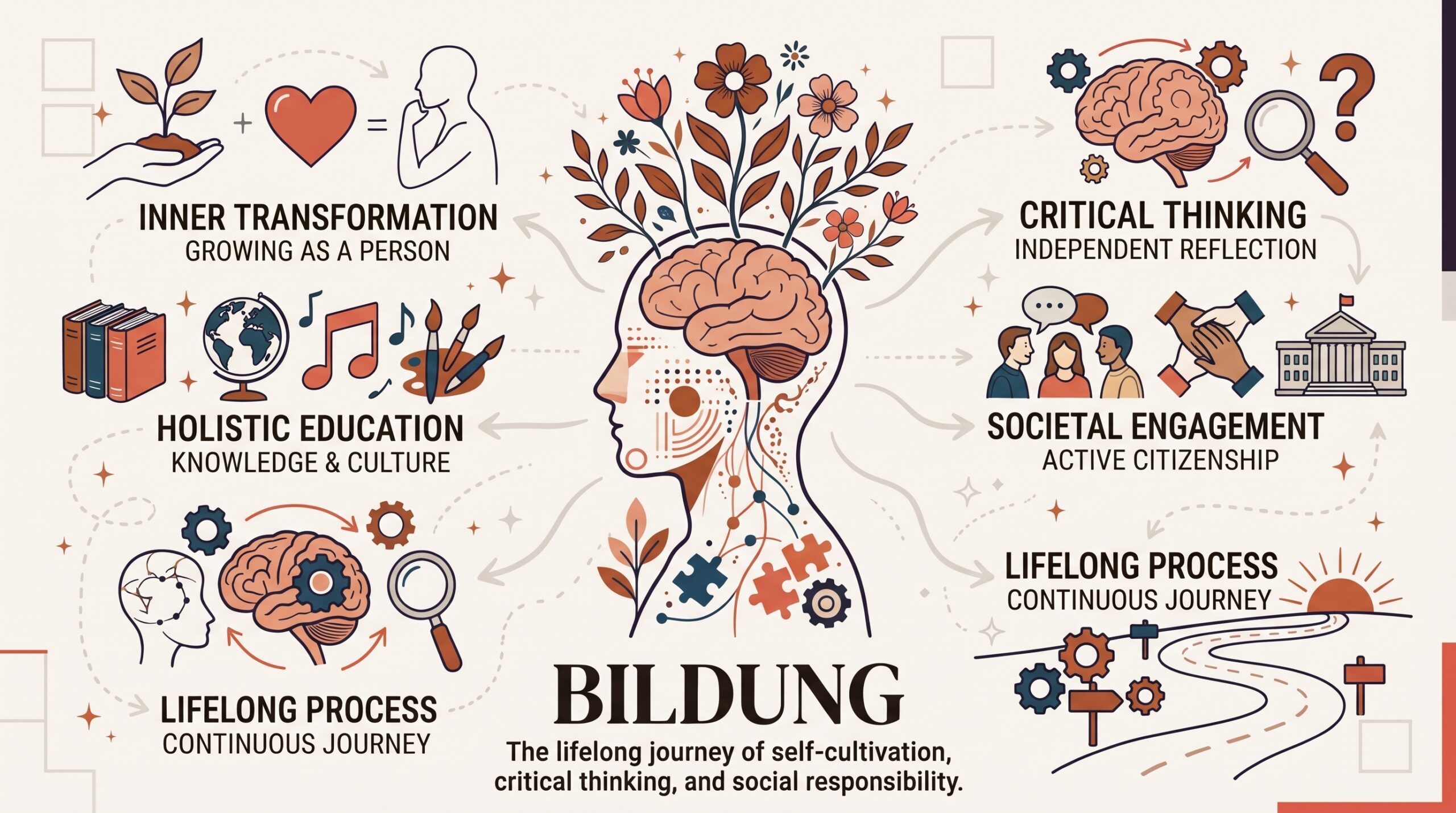
Modern capitalism has deeply misunderstood and hijacked this Goethean concept of striving, transforming it into the toxic phenomenon of hustle culture. On the surface, the modern hustler and the Faustian striver look similar: both are restless, both are always in motion, both refuse to settle. But their underlying ontologies are entirely opposed.
Hustle culture is extractive. It is driven by the accumulation of external markers of success: wealth, status, followers, promotions. The hustler treats their own life as a business to be scaled. When the external rewards disappear, the striving collapses into burnout and disappointment.
Faustian striving is the opposite, it is inward-facing. It is the engine of Bildung. The goal is not to accumulate, but to become. The striving is not for a higher tax bracket. Faust is ultimately saved from damnation in the final act of the play not because he achieved moral purity but because his spirit never stagnated.
How, then, do we translate the lofty ideals of Bildung and Faustian striving into the realities of the modern workplace? We cannot all be geniuses like Goethe, writing masterpieces of world literature while also discovering new anatomical bones and theorizing on the nature of color. Most of us are bound by the necessity of earning a wage in a system that heavily favors the division of labor.
Bildung requires what modern psychologists call job crafting, the active renegotiation of the boundaries and nature of our work to align it with our own development.
To work with a spirit of Bildung means refusing to let a job description define your world. It means actively seeking out the friction that forces us to grow. If our work is solitary and screen-bound, Bildung calls us to the physical, the communal, and the tangible. But it also means bringing the totality of who we are into the work itself.
The best ideas and innovations rarely come from those who operate strictly within the narrow parameters of their specialization. They come from the polymaths and individuals who can connect the poetic with the pragmatic, who can see the person behind the data point.
By connecting Bildung to the world of work one can begin to bridge the divide between who we are and what we do for a living. In a culture that pressures us to narrow our focus and to optimize our performance, embracing Goethe’s vision of Bildung is an act of rebellion. It is a refusal to be simplified. It is a demand that we remain vast, restless, and completely, unapologetically whole.