
In 1974, the psychologist Herbert Freudenberger published a study observing a peculiar phenomenon among staff at a free clinic in New York City. The idealists who had dedicated themselves to assisting unhoused and addicted populations were suffering from physical exhaustion, emotional depletion, and a cynicism that seemed to erode their once-vibrant commitment. Freudenberger borrowed a term from the drug culture of the era to describe this state: burnout.
Half a century later, burnout has migrated from a hyper-specific observation about overextended social workers to an all-encompassing diagnosis of contemporary life. It is cited in human resources handbooks, corporate wellness seminars, self-help bestsellers, and clinical psychology journals. In 2019, the World Health Organization officially recognized burnout in its International Classification of Diseases as an occupational phenomenon.
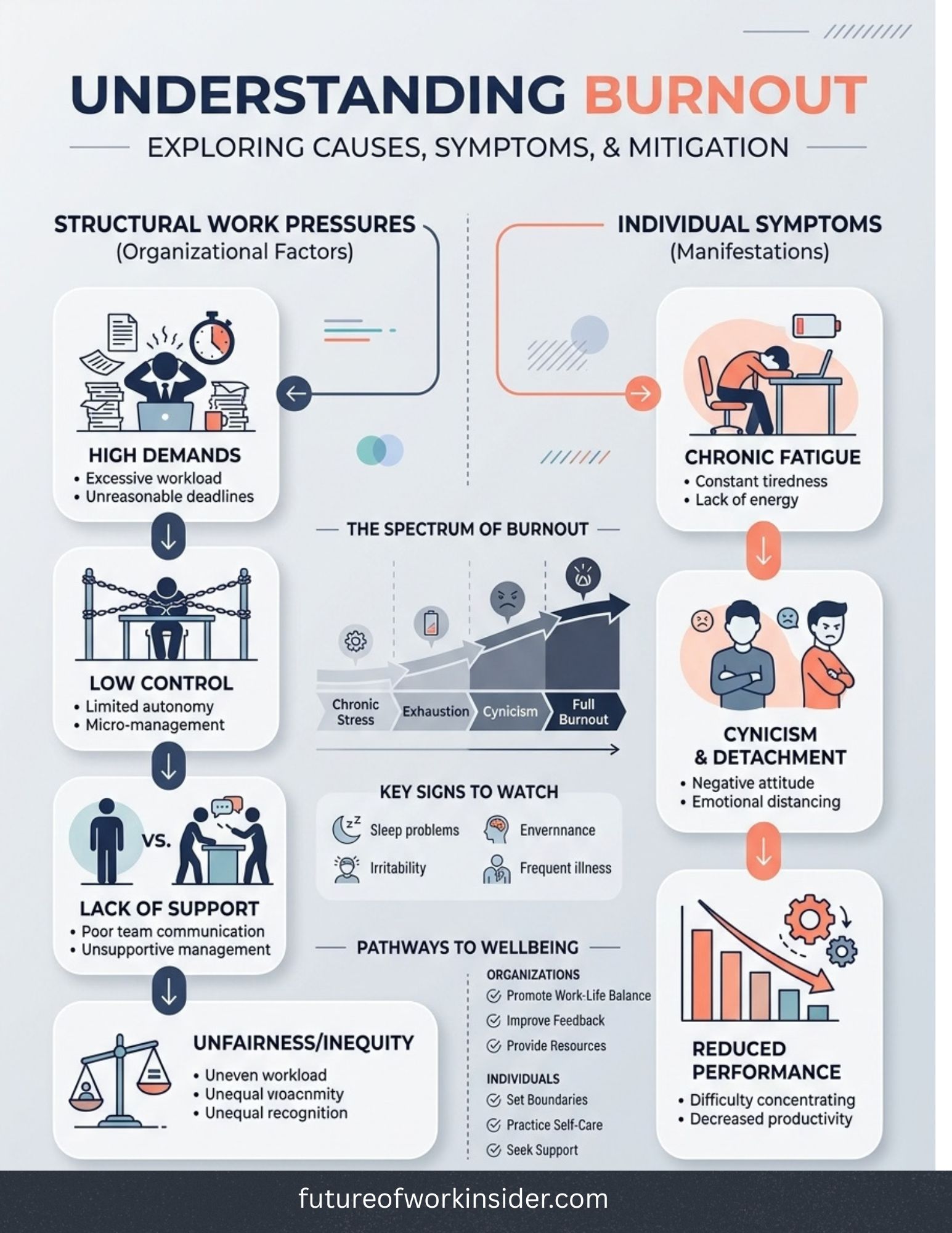
Yet, as the vocabulary of burnout has proliferated, its diagnostic power has inverted its political meaning. What began as an observation of structural overreach has been systematically transformed into a clinical pathology residing inside the individual worker. By framing workplace exhaustion as an internal psychological dysfunction, a failure of resilience, boundary-setting, or neurochemical balance, modern society performs a subtle act of political erasure. Burnout pathologizes what is, at its core, a rational human response to unviable economic conditions. It domesticates refusal, turning a potential political revolt into a clinical case to be treated.
The Privatization of Structural Distress
To understand how burnout became medicalized, one must trace the shift in how labor disputes have been conceptualized over the past century. In the industrial era, when work conditions became untenable, when hours grew too long, quotas too severe, or environments too hazardous, the response was collective and outward-facing. Workers went on strike, formed unions, or engaged in sabotage. The distress caused by work was understood as an irreducible conflict of interest between capital and labor.
Under late capitalism, however, the boundary between the self and the wage-earning apparatus has dissolved. As the philosopher Byung-Chul Han argues in The Burnout Society, contemporary working life has transitioned from a discipline-based system of external rules to an achievement-oriented system of internal compulsion. We are no longer driven primarily by external overseers; we are driven by an internalized command to optimize, iterate, and realize our potential through labor.
When exhaustion inevitably sets in under this regime, the system cannot afford to acknowledge that the demands of hyper-productivity are structurally impossible. Instead, it offers a diagnostic mirror: You are burnt out.
The tragedy of this medicalization lies in its privatization of distress. Mark Fisher coined the term “reflexive impotence” to describe how people recognize the brokenness of a system but feel powerless to alter it. The clinical framework of burnout accelerates this impotence. If exhaustion is an individual pathology, then the solution must also be individual. The worker is prescribed cognitive behavioral therapy to reframe negative thought patterns, mindfulness apps to regulate a frantic nervous system, or “resilience training” to expand their capacity for endurance.
Notice the cruel optimism inherent in these interventions: they leave the external drivers of exhaustion untouched while demanding that the worker build a stronger internal dam to contain the rising tide. The corporate wellness industry, now valued at over $50 billion globally, functions less as a remedy for suffering than as a maintenance system designed to return spent labor to operational status.
The Demand for Emotional Alignment
This diagnostic trap is compounded by the changing nature of work itself. In knowledge, service, and care economies, labor is no longer merely a physical transaction; it is an emotional and identity-driven obligation. Employers do not simply ask for eight hours of physical presence; they demand enthusiasm, alignment with corporate values, and a performative dedication to the organization’s mission.
When work demands the total mobilization of the self, exhaustion ceases to be merely physical—it becomes existential. To feel disaffected, unmotivated, or cynical in such an environment is not seen merely as fatigue; it is viewed as a moral failure or a psychiatric symptom.
By categorizing this disaffection as “burnout,” the institution performs a double maneuver:
- It validates the worker’s suffering just enough to maintain moral authority.
- It strips that suffering of its critical edge.
Cynicism, detachment, and emotional distance—three classic diagnostic criteria of burnout—are not inherently pathological. In many cases, they are protective psychological mechanisms, an intuitive defense system deployed by the mind to establish boundaries against an overreaching institution. By labeling these defenses as symptoms of a syndrome, we persuade workers that their instincts of self-preservation are illness.
From Clinical Pathology to Political Critique
What would happen if we stopped viewing burnout as an illness to be cured and began viewing it as a legitimate form of refusal?
In the early 1970s, the Italian feminist movement launched the Wages for Housework campaign, demanding economic recognition for unpaid domestic labor. Their goal was not simply financial compensation, but a redefinition of work itself that exposed the hidden structures sustaining the economy. Reclaiming burnout requires a similar conceptual shift.
Exhaustion is an embodied critique of an economic model premised on infinite expansion within finite limits—both ecological and physiological. When a worker experiences burnout, their body is asserting a limit that their mind, socialized into constant productivity, has been trained to deny. It is a involuntary strike of the nervous system.
Treating this nervous system revolt with mindfulness apps and therapy is akin to placing a piece of tape over an engine warning light so the car can keep driving. To move beyond this distraction, we must shift our vocabulary from the medical to the political.
Until we reclaim exhaustion as a collective political condition rather than an isolated clinical defect, “burnout” will remain what capitalism needs it to be: a convenient diagnosis that keeps the machine running while convincing the broken pieces that the breakdown was entirely their own fault.