How working like a bioluminescent organism can help us to understand a new layer of productivity!
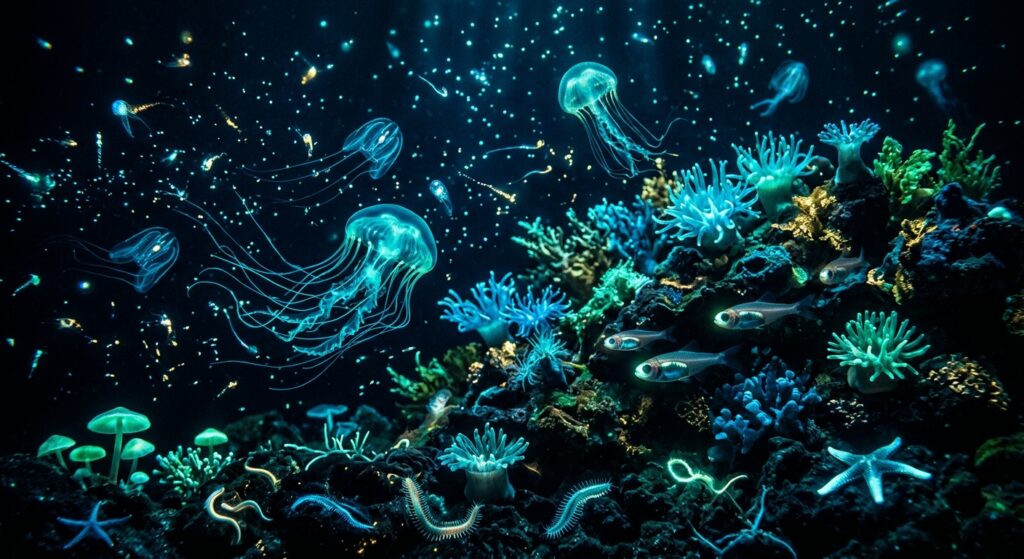
Deep in the twilight zone of the open ocean, six hundred meters below the surface, the dark is not absolute. It is punctuated by sudden, precise bursts of cool blue light. A deep-sea shrimp releases a cloud of glowing mist to dazzle a predator; a anglerfish suspended in the abyss sparks a solitary, seductive lure; a soil fungus beneath a forest floor hums with a faint, greenish phantom glow.
Bioluminescence, the capacity of living organisms to manufacture their own light—is one of nature’s most persistent inventions. Occurring through a chemical interplay where an enzyme catalyst (luciferase) oxidizes a fuel molecule (luciferin), this cold-light phenomenon has evolved independently at least 94 separate times across the tree of life. It is not an anomaly, but a converging solution to the fundamental problem of survival in the dark.
For centuries, industrial productivity has operated on the logic of incandescent bulbs: raw, high-friction energy burned hot and long to illuminate the dark through brute force. Yet, the evolutionary history of biological light offers a radical alternative model for how we generate focus, manage energy, and illuminate our work.
Metabolic Efficiency Over Brute Force An incandescent bulb converts less than 10 percent of its energy into visible light; the remaining 90 percent is lost as waste heat. Bioluminescence, by contrast, approaches near-100 percent thermal efficiency. It is “cold light,” producing illumination without burning through the host organism’s vital reserves. In modern knowledge work, burnout is the direct result of working like a filament bulb—generating massive internal friction, anxiety, and metabolic waste just to stay visible. Bioluminescent productivity prioritizes targeted, low-friction output. It asks: What is the minimal viable energy required to generate a brilliant, distinct idea?
Antioxidants Before Architecture Evolutionary biologists hypothesize that bioluminescence did not begin as a communication tool. Instead, it likely originated as a metabolic cleanup strategy. Early luciferins acted primarily as antioxidants, mopping up volatile, reactive oxygen species that threatened to damage cellular machinery. The light was simply a byproduct of internal detox.
In our working lives, deep focus often fails because we attempt to build complex outputs atop a cluttered, high-stress internal landscape. True output functions best when we first practice metabolic maintenance—clearing cognitive debris, reducing reactive multitasking, and processing stress. Illumination happens naturally once the internal ecosystem is detoxified.
Adaptive Signaling in the Abyss No organism glows constantly without purpose. The firefly flashes in rhythmic, precise intervals to communicate with potential mates; the vampire squid ejects a localized burst of glowing mucus only when threatened, using the light as a temporary decoy while it vanishes into the dark.
The open ocean teaches us that visibility should be intentional, not continuous. Modern workplace cultures often demand constant, low-grade ambient glow—endless green status dots, real-time chat updates, and perpetual availability. A bioluminescent approach replaces continuous presence with dynamic signaling: long stretches of quiet, dark deep-work interrupted only by brilliant, highly focused flashes of output and communication.
To work like a bioluminescent organism is to abandon the myth of the endlessly burning industrial sun. It is a transition toward a cold-light framework: energy-efficient, internally clear, and capable of shining precisely when the surrounding world needs it most.