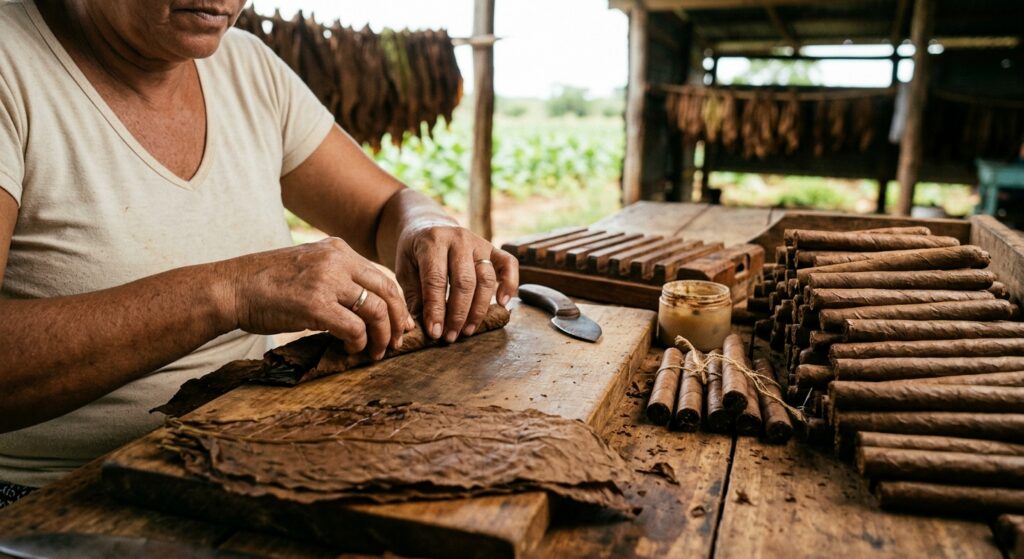
Did you know that Cuban cigars, especially the renowned Cohiba, dominate the global cigar market by approximately 70% (outside of the US)? The US market is usually served by Nicaragua (with Cuban seeds). More interesting than that is the dominant labor statistics for these tobacco farms.
In 2011, a group trip to study the potential and challenges for the tourism industry in Cuba led to some unique expereinces and findings. Women account for 60% to 70% of the overall labor force across Nicaragua’s tobacco fields. In Cuba, Women make up roughly 15% to 20% of the direct field labor force on tobacco farms, but their representation surges to 60% to 90% in post-harvest processing and factory production.
For decades, global luxury branding built its prestige around a hyper-masculine myth: the rugged patriarch tending high-altitude coffee trees in the Andes, or the stern male torcedor painstakingly hand-rolling Cohibas in Havana.
However, beneath this imagery lies an inconvenient economic reality. In both luxury craft and global agriculture, women have long performed the vast majority of the delicate, labor-intensive work. Performing labor, though, is not the same as holding power.
From Leaf-Strippers to Master Rollers
In colonial and early 20th-century Cuba, tobacco factories were fiercely stratified along gender lines. The prestige roles on the factory floor belonged exclusively to male torcedores (master rollers), who sat prominently near the windows, crafting cigars for export while a lector read news and classic literature aloud to the room.
Women, meanwhile, were exiled to dark, poorly ventilated backrooms as despalilladoras (leaf strippers). Their task was messy, hazardous, and low-paid: removing the central vein from damp tobacco leaves to prepare them for the rollers.
The structural shift began in the mid-20th century. In 1966, Havana’s El Laguito factory was established to produce high-grade cigars specifically for diplomatic gifts and top state officials, a line that would become the world-famous Cohiba brand. El Laguito made a radical operational choice: it hired and trained an all-female workforce of rollers, betting that female artisans brought superior precision, dexterity, and consistency to the leaf-wrapping process.
Today, torcedoras represent a major proportion of Cuba’s master cigar rollers. Women now command the highest tier of artisanal craftsmanship in the industry, while female lectoras frequently read politics, history, and poetry to the factory floors.
Coffee’s Invisible Laborers
A similar dynamic defines the global coffee economy. In Vietnam, the world’s second-largest coffee producer, as well as across Latin America and East Africa, women perform up to 70 percent of field labor. They sow seedlings, pick ripe cherries, and sort defective beans by hand.
Despite providing the physical backbone of the supply chain, women historically owned less than 15 percent of coffee farmland and held virtually no directorships in local agricultural cooperatives. They were workers in an industry managed by men, selling to international buyers managed by men.
In Vietnam, companies like Detech Coffee, led by CEO Ngoc Anh, are shifting the narrative. Rather than treating coffee as an extracted primary commodity, Detech treats it as a financial asset capable of driving community equity. By organizing thousands of ethnic minority smallholders, providing technical training, and securing institutional impact capital (such as blended debt facilities via IIX and Incofin), female-led management has achieved remarkable growth while increasing farmer payout ratios.
When female leadership enters the supply chain, the operational metrics change: studies consistently show that women-led cooperatives reinvest a significantly higher share of revenue into climate-resilient farming tools, community education, and household financial reserves.
The Long Shadow of Extraction
To understand why the hands that harvest our most treasured crops rarely own the soil, we have to look past modern marketing and into the architecture of agrarian history. For centuries, global food and cash-crop systems were built on a deliberate separation between cultivation and control.
From the plantation economies of the Caribbean and Latin America to the enclosures of European commons, agricultural wealth depended on keeping land titles, credit, and export licenses concentrated in a few hands while treating human labor as an elastic, expendable input.
Even after formal emancipation and land reforms swept across the 20th century, that structural asymmetry persisted in quieter forms. Industrial agriculture rewarded monoculture: vast, uniform tracts of a single cash crop engineered for predictable yields and frictionless global shipping. In that model, women’s labor was systematically categorized as supplementary precisely because acknowledging its technical complexity would have required paying for it, or worse, sharing governance. Yet anyone who has watched a despalilladora gauge the moisture of a wrapper leaf by touch, or a smallholder farmer in the Vietnamese highlands selectively pick only crimson cherries across three staggered harvests, knows that agricultural survival has always rested on intimate ecological literacy. The end products that we have come to love are delicatly, expertly crafted.
Heat, Fragility, and the End of Cheap Abundance
That ecological literacy is suddenly becoming our scarcest resource. The industrial model of agriculture assumed a stable climate,including predictable rains and temperate seasons against which global supply chains could optimize for efficiency. That assumption is now fracturing.
In February 2026, a landmark attribution analysis by Climate Central revealed that across the 25 countries responsible for 97 percent of global coffee production, carbon pollution added an average of 47 extra days of coffee-harming heat every year between 2021 and 2025.
In the top five producing nations alone, which supply three-quarters of the world’s beans, crops endured 57 additional days of damaging heat annually. Arabica, the delicate highland species prized for specialty coffee, is acutely vulnerable to thermal stress and erratic rainfall; following severe droughts in Brazil and erratic harvests across Latin America, global arabica and robusta prices nearly doubled between 2023 and early 2025. Even as bumper harvests occasionally offer brief market reprieves, the underlying biological reality remains grim: the middle latitudes of our modern breadbaskets are overheating.
Coffee an isolated casualty. In mid-2025, a study in Nature warned that rising temperatures will inflict substantial yield losses across global staple crops by the end of the century. The same study found that it would hit temperate, high-output farming regions hardest. By September 2026, the European Union’s Joint Research Centre reported that an exceptionally hot, dry summer across western and central Europe had slashed yield forecasts well below five-year averages for soybeans, maize, potatoes, and sugar beet.
The luxuries we take for granted at the breakfast table like a morning espresso are at risk.
The Cooperative Future
When global supply chains brittle under climatic pressure, top-down industrial farming hits a wall. A distant corporate buyer cannot micromanage soil moisture, shade-tree canopy density, or pest outbreaks across ten thousand microclimates.
Resilience requires granular, localized stewardship and that is precisely where the quiet revolution led by women in agricultural cooperatives becomes a blueprint for the future. We saw this first hand visiting the Vietnamese coffee plantations in Da Lat.
Across coffee belts from Vietnam to Nicaragua, shade-grown agroforestry is proving essential to buffering crops against 30°C heat spikes. Transitioning to agroforestry requires patient capital, shared nurseries, and collective risk-taking. Individual smallholders operating in isolation cannot absorb a two-year dip in yield while shade canopies mature. Cooperatives can. By pooling harvests, sharing processing infrastructure, and negotiating directly with roasters and exporters, producer cooperatives convert isolated vulnerability into collective bargaining power.
At the same time, climate volatility in distant export hubs is forcing a parallel reckoning closer to home. As international freight grows more expensive and tropical commodities become prone to sudden supply shocks, communities in the Global North and South alike are rediscovering the necessity of local food webs—community-supported agriculture, municipal seed banks, regional grain mills, and neighborhood food cooperatives. In both cases, the logic is identical: shortening the distance between the people who tend the land and the people who depend on its harvest.
The eras of cheap abundance and invisible labor were twin illusions sustained by a forgiving climate. As the weather turns volatile, the future of food and craft will belong to the cooperative table. Those organisations rooted in local soil, governed by the hands that work it, and sustained by the act of sharing both risk and harvest.
Are you a producer or farm owner? We would love to hear your thoughts about the future of farming.