Are We going to be forced into a radical reconsideration of economic value, human purpose, and the nature of work?
For most of human history, labor has been a relentless prerequisite for survival an unyielding bargain struck between the necessity of bread and the sweat of the brow. Yet, as artificial intelligence accelerates and mechanical automation steps off the factory assembly line into the physical substrate of daily life, a growing cadre of technologists argues that this fundamental condition of human existence is approaching its expiration date.
Chief among them is Elon Musk. In a wide-ranging interview with The Economist, set alongside years of his public musings, Musk articulated a vision of the future where human labor is no longer an economic necessity, but a lifestyle choice.
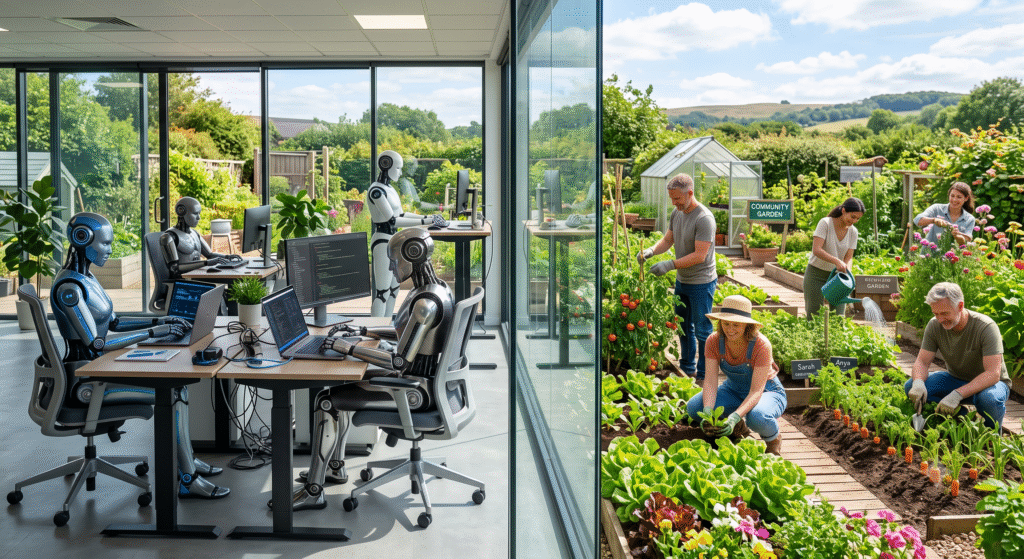
“My prediction”, Musk noted, “is that work will be optional.” He likened future employment to tending a backyard vegetable garden: something a person might undertake not because they depend on the yield to avoid starvation, but because they derive intrinsic pleasure from the dirt, the seeds, and the process itself.
It is a heady, utopian thesis. Yet, as society stands on the precipice of what Musk calls an era of “quasi-infinite abundance,” his vision raises profound questions that extend far beyond technology. If the age of compulsory labor is indeed drawing to a close, what happens to the human engine when the gear of work is disengaged?
The Economic Physics of Infinite Abundance
At the core of Musk’s hypothesis lies a straightforward, if radical, economic equation. Traditional economics is the study of scarcity how finite resources, constrained by human labor and raw material, are distributed among infinite desires.
Musk’s counter-thesis hinges on two technological pillars:
- Digital General Intelligence: AI systems capable of outperforming humans across cognitive tasks, software engineering, and scientific synthesis.
- Humanoid Robotics: Physical agents (such as Tesla’s Optimus) capable of navigating human infrastructure, building goods, and delivering manual labor at a marginal cost that trends asymptotically toward zero.
When cognitive and physical labor are fully decoupled from human biological limits, the cost of producing goods and services collapses. In Musk’s estimation, this transition inevitably triggers an era of extreme deflation. If machines produce food, build shelter, deliver healthcare, and generate energy with minimal human intervention, the traditional mechanisms of trade and wages fracture.
Under this framework, traditional Universal Basic Income (UBI) is insufficient. Musk advocates instead for Universal High Income a state where government dividend checks, funded by the hyper-productivity of automated capital, grant every individual access to virtually any standard of living they desire. Money itself, Musk argues, may eventually lose its meaning. When the supply of goods is effectively infinite, currency ceases to act as a mechanism for rationing scarcity.
The Paradox of the Silicon Stakhanovite
There is, of course, an ideological tension at the heart of Musk’s narrative. The man championing a post-labor future of leisure and creative hobbies is the same executive famous for sleeping on factory floors, demanding 100-hour workweeks, and railing against remote work.
| Near-Term Reality | Long-Term Vision |
| Relentless Human Labor: Hyper-intense work cultures at xAI, Tesla, and SpaceX to overcome engineering bottlenecks. | Automated Voluntary Work: A post-scarcity state where labor becomes an aesthetic or therapeutic choice. |
| Capital Allocation & Stakes: Navigating intense competition, regulatory scrutiny, and compute bottlenecks. | Post-Monetary Value: A world where wealth is decentralized into raw energetic and physical limits rather than currency. |
This paradox reveals how Musk views the current historical moment: as a hyper-compressed bridge period. To build the very infrastructure required to liberate humanity from labor, an extraordinary exertion of human effort is temporarily required. The relentless grind of today is framed as the fuel for tomorrow’s effortless equilibrium.
Searching for Meaning Beyond the Job
If the technical and economic hurdles of this automated paradise are somehow overcome, society faces an even steeper challenge: an existential one.
For centuries, work has provided humanity with more than just a paycheck. It offers structure, social identity, community, and a sense of mastery. Sociological research consistently demonstrates that losing a job inflicts psychological harm that far exceeds the financial loss alone; it fractures a person’s sense of purpose and social coherence.
If a robot can perform surgery more precisely, paint more evocatively, write code more cleanly, and construct a home more efficiently than any human, where does human pride reside?
Musk acknowledges this psychological abyss. When machines outperform humans across every quantifiable metric, humanity may find itself playing the role of the ultimate arbiter of meaning serving not as the producers of value, but as the conscious entities for whom value exists at all.
The Unsettled Horizon
Whether Musk’s timeline, spanning the next one to two decades, is an accurate forecast or tech-industry hubris remains heavily debated by economists and roboticists, who point to lingering physical constraints, energy grid limits, and complex regulatory landscapes.
Yet, the paradigm shift he describes forces us to confront a fundamental question before the technology fully arrives: If human worth is no longer measured by economic output, how will we choose to define a meaningful life?
In the end, a future of optional work may not be a simple story of endless leisure. It may prove to be humanity’s most demanding philosophical project yet: learning how to flourish when we are no longer required to work.
To explore this debate further, The Economist published an insightful sit-down interview detailing these predictions and the surrounding economic debates: Elon Musk on Europe, the far right and civil war in Britain | The Economist.