
As AI language engines dissolve the barrier between intention and execution, coding is ceasing to be a craft of mechanical writing and becoming an exercise in pure philosophical architecture.
For generations, entering the priesthood of computer technology required submitting to a peculiar linguistic ritual. One had to learn to express human desires through a matrix of mechanistic syntax. A misplaced semicolon, an unclosed bracket, or an incorrect indentation depth was not merely an error; it was a systemic collapse, an instant refusal by the machine to understand. Programming was less about pure thought than it was about manual negotiation. For many years now developers have been writing code in languages which are foreign to most of us. Python, C++, or JavaScript were reserved for those that were willing to put in the hard graft of learning these amazing coding dialects.
Today we are witnessing a quiet, profound expiration. It is the dawn of what the tech industry calls ‘vibe coding’ a seemingly casual moniker that hides a radical truth. Today, the mechanical friction of computing has been largely automated away. With modern autonomous AI engines handling upwards of 85% of routine syntax, software creation is transitioning into a conversational act. Natural language has become the final
compiled layer. As we look toward the horizon of the next decade, a fundamental question emerges for thinkers, workers, and educators alike: when human language becomes the primary development interface, what happens to the human mind that used to code?
THE RISE OF THE ORCHESTRATOR
To understand this shift, one must observe how modern software engineering is executed. In corporate environments, the archetypal image of a developer staring intensely at thousands of line-by-line scrips is being replaced by something entirely different. Engineers now act as system editors, prompt directors, and cognitive governors.
Artificial intelligence has proven remarkably fluent at generating the logical boilerplate of our digital infrastructure. If you ask an autonomous agent to construct a secure database connection or write standard validation protocols, it doesn’t just suggest lines of code, it builds, packages, tests, and deploys them. The human value has moved up the stack. It has shifted from the mechanical generation of the component to the orchestration of the whole.
“Calculators did not kill mathematics; they merely freed the mathematician from the
prison of long division to focus on the beauty of calculus. Similarly, AI is freeing humanity
from the minutiae of syntax so we can become true digital architects.”
THE SOCRATES WARNING FOR THE DIGITAL AGE
However, this liberation comes with a distinct philosophical anxiety. In his dialogue Phaedrus, Socrates famously argued against the invention of writing. He warned that relying on external symbols would implant forgetfulness in the souls of learners, causing them to cease exercising their memory. They would become consumers of information without true wisdom, possessing the reputation of knowledge rather than knowledge itself.
We face a digital version of the Socratic dilemma. If future generations of technologists build systems entirely through conversational directives without ever grasping memory leaks, data structures, or algorithmic complexity, we risk establishing a society dependent on a deeply complex infrastructure that no single human being truly understands. When the AI generates thousands of lines of flawless syntax containing a deeply buried, structurally catastrophic logical flaw, only a mind trained in the rigorous crucible of computational logic can diagnose the failure.
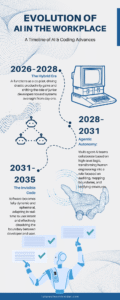
A TIMELINE OF THE GREAT DEMATERIALIZATION 2026 – 2035
2026 – 2028: The Hybrid Era.
AI acts as a co-pilot. Productivity multipliers scale drastically. The job market ceases to
value the purely task-oriented script-writer, forcing junior developers to behave like
mid-level systems overseers from day one.
2028 – 2031: Agentic Autonomy.
Multi-agent AI teams collaborate autonomously based on high-level business logic.
Human engineering becomes an exercise in auditing, system boundaries mapping, and
structural verification.
2031 – 2035: The Invisible Code. Software becomes fully dynamic and ephemeral, generating and adapting itself in real-time based on immediate user intent. The boundary between developer and user effectively dissolves.
REBUILDING THE EDUCATIONAL PIPELINE
Confronted with this reality, the educational structures of higher learning cannot merely tweak their syllabus. Educators must reconstruct their foundational philosophy. The traditional pedagogical formula of introductory computer science courses, memorizing a language’s specific syntax rules, is increasingly obsolete. The focus must pivot drastically from code writing to code comprehension.
The classrooms of leading institutions are already experimenting with a layered approach. In the foundational sandboxes of the first semesters, AI tools are strictly partitioned. Students are forced to grapple manually with the raw, brutal basics: pointers, memory allocations, and discrete mathematical structures. They must understand the physics of the machine.
However, once those first principles are proven, the AI restriction vanishes. In upper-level courses, students are expected to leverage autonomous agents to build massive, full-stack enterprise applications that would have historically required a team of senior engineers a full semester to complete. We must teach them how to think with exquisite, flawless clarity in their own. We are not moving away from computer science; rather, we are elevating it.
The future belongs not to those who can type the fastest or memorize the most libraries, but to those who possess the architectural vision to see how systems connect, the ethical depth to evaluate their impact, and the logical discipline to guide the machine’s immense, autonomous power.