
When people talk about the global AI race, the assumption is usually simple: richer countries adopt artificial intelligence first, poorer countries catch up later.
That part is true. But the latest findings from Anthropic’s Economic Index reveal something far stranger hiding underneath the adoption gap.
The countries using AI less are often using it in a fundamentally different way. Not as a collaborator. Not as a creative partner. Not as a learning tool. But as a substitute for human labor.
Anthropic’s data, drawn from millions of Claude conversations across more than 150 countries, found a surprising inverse relationship: countries with lower AI adoption were more likely to use AI for direct automation, while high-adoption economies tended to use AI collaboratively.
At first glance, this sounds counterintuitive. Shouldn’t advanced economies be automating faster?
Instead, the opposite pattern appears to be emerging:
- richer economies use AI to augment workers,
- poorer and lower-adoption economies use it to replace tasks outright.
And that distinction may become one of the defining fault lines of the AI era.
The Strange Geography of AI
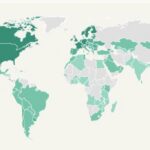
Anthropic’s report shows AI adoption is overwhelmingly concentrated in wealthy economies. Singapore, Australia, Switzerland, Canada, and the United States dramatically over-index in AI usage relative to population. India, Indonesia, and Nigeria lag far behind.
The company found a remarkably strong correlation between GDP per capita and AI adoption:
every 1% increase in national income corresponded to roughly a 0.7% increase in Claude usage.
This mirrors the spread of earlier transformative technologies: electricity, computers, broadband, industrial machinery. The rich world gets there first. But what Anthropic uncovered goes beyond access.
It suggests that countries may be developing entirely different cultures of AI use.
Rich Countries Talk to AI. Poorer Countries Delegate to It.
Anthropic divides AI interactions into two broad categories:
- augmentation: humans and AI collaborate iteratively,
- automation: AI performs tasks with minimal human involvement.
The pattern they observed was striking. High-adoption countries leaned toward collaborative use: brainstorming, learning, iteration, refinement.
Lower-adoption countries were significantly more likely to hand complete tasks to AI systems.
Even after controlling for task type, Anthropic found that a 1% increase in AI usage per capita correlated with roughly a 3% reduction in automation-oriented interactions.
In other words: the more deeply AI penetrated an economy, the less people tended to use it as a direct replacement for labor.
That raises an unsettling possibility. What if the global AI divide isn’t simply about who has access to the technology but about who learns to work with it?
Why Would Lower-Adoption Countries Automate More?
Anthropic admits it does not yet fully understand the phenomenon. But several explanations begin to emerge when the data is viewed through economic history.
1. AI Is More Valuable When Labor Is Scarce
In high-income economies, labor is expensive. A lawyer, consultant, engineer, or analyst in San Francisco or Zurich may cost hundreds of dollars per hour. AI therefore becomes economically valuable as a collaborative productivity amplifier.
The worker stays. Output increases.
But in many lower-income economies, labor markets work differently. Wages are lower. Margins are thinner. Work is often outsourced and task-oriented. Under those conditions, AI becomes attractive not as augmentation, but as direct substitution.
The logic shifts from:
“How can AI make this worker more productive?”
to:
“Can AI do this task instead?”
2. High-Adoption Economies Have More AI Literacy
Anthropic’s broader research increasingly suggests that experienced AI users behave differently from newer users.
Power users:
- iterate more
- refine prompts
- verify outputs
- collaborate with models
- treat AI as a thinking partner rather than a vending machine
This may explain why mature AI ecosystems drift toward augmentation. People learn the limitations of the systems. They stop trusting AI blindly. Ironically, the societies most immersed in AI may become the least likely to delegate fully to it.
Meanwhile, lower-adoption regions may still be in the magic phase of AI adoption: high trust, high novelty, high willingness to automate.
3. Language and Infrastructure Matter
There may also be structural reasons for the divide. Recent research on AI diffusion in low-resource language countries found that nations with weaker language support in frontier models show significantly lower AI adoption overall. When AI systems perform inconsistently in local languages or contexts, collaborative use becomes harder.
The easiest use cases become:
- code generation,
- templated automation,
- repetitive digital tasks.
That aligns closely with Anthropic’s findings. In India, for example, coding-related tasks account for more than half of Claude usage, compared to roughly one-third globally. High-adoption countries show much more diversified use: education, science, business operations, creative work.
This may matter enormously for long-term economic development. Because augmentation and automation do not create the same economic outcomes.
Automation Economies vs Augmentation Economies
The difference sounds subtle but it is not.
An augmentation economy uses AI to increase the productivity of skilled workers. An automation economy uses AI to reduce dependence on workers. Those paths can lead to radically different futures.
Historically, technologies that complemented skilled labor often increased wages and productivity simultaneously. Technologies that substituted directly for labor often concentrated gains into capital ownership while compressing employment and bargaining power.
Anthropic itself warns that current AI adoption patterns could widen global inequality rather than narrow it. If wealthy economies become better at integrating humans and AI together, while poorer economies primarily automate discrete labor tasks, the productivity gap between nations could widen dramatically.
The countries already ahead may compound their advantage.
The Future May Depend on How Humans Position Themselves Relative to AI
The deeper implication of Anthropic’s findings is philosophical as much as economic. In richer countries AI is working with institutions. This may not be the case for under developed or developing countries that don’t have these institutions in place. A key question that needs to be answered is how education, politics, financial systems and societal norms could be affected by this delegation to AI working solo.
The countries thriving in the AI era may not simply be the ones with the best models. They may be the ones that culturally normalize a different relationship to machines. Not obedience. Not replacement. Collaboration. That distinction sounds abstract today.
But it may ultimately determine:
- which countries create new industries
- which workers retain bargaining power
- which economies generate broad prosperity
- and which become dependent on increasingly automated digital labor.
The real AI divide may not be between countries that have AI and countries that do not. It may be between societies that use AI to extend human capability and societies that use it to route around humans altogether.
Don’t forget to Save for Later