Silicon Valley spent years selling us two competing futures. In one version, AI would become a superhuman productivity engine that frees people from drudgery. In the other, it would trigger mass unemployment and social collapse. The debate became cartoonishly binary: utopia or extinction, abundance or robots taking your job.
But the latest research from Anthropic’s Economic Index suggests something stranger and arguably more unsettling is already happening.
Not mass unemployment. Not robot uprisings. Something slower. Something quieter. Something that changes how careers work.
Using millions of anonymized Claude interactions, Anthropic mapped where generative AI is actually being used in the economy. The findings don’t look like science fiction. They look like the early stages of a labor market rewrite already underway inside offices, startups, banks, and software teams.
Here are the seven most thought-provoking insights from the report and why they matter far beyond the tech industry.
1. AI Is Coming for the Good Jobs First
For decades, automation anxiety centered on physical labor:
- factory workers,
- truck drivers,
- warehouse employees.
But generative AI has flipped the script.
The workers most exposed right now aren’t manual laborers. They’re:
- programmers,
- analysts,
- researchers,
- writers,
- customer support workers,
- administrative professionals.
Meanwhile, many physical trades remain comparatively resilient:
- electricians,
- plumbers,
- mechanics,
- healthcare aides,
- construction workers.
This is one of the strangest reversals in modern economic history.
The jobs society spent decades telling young people to pursue knowledge work, coding, office jobs, safe professional careers are suddenly the jobs AI can most easily assist, compress, or partially automate.
The future may not belong to the people furthest from physical labor.
It may belong to the people closest to reality.
2. The Biggest Casualty May Be the Career Ladder Itself
The most important finding in Anthropic’s research isn’t layoffs.
It’s the disappearance of beginner work.
For generations, white-collar professions operated on apprenticeship:
- junior developers,
- research assistants,
- paralegals,
- analysts,
- coordinators,
- interns.
These jobs often existed because organizations needed humans to handle repetitive cognitive labor:
- summarizing documents,
- cleaning spreadsheets,
- writing first drafts,
- handling support tickets,
- producing boilerplate code.
Now AI can do a shocking amount of that work instantly.
Which raises a terrifying question:
If AI handles junior tasks, how do humans become senior?
This is the labor-market problem almost nobody is talking about. Not because it’s dramatic but because it’s structural.
A society can survive layoffs.
It’s much harder to survive a world where young workers never get a foothold in the first place.
3. AI Isn’t Replacing Workers Yet. It’s Making the Best Workers Dangerous.
One of the report’s most fascinating findings is that AI usage is still mostly “augmentation,” not full automation.
Humans are still supervising, editing, and directing AI systems.
But that may actually increase inequality inside professions.
A top-tier employee using AI effectively can suddenly operate at astonishing scale:
- a programmer shipping far more code,
- a marketer generating campaigns instantly,
- a consultant producing research in hours instead of weeks.
In other words, AI may not eliminate workers equally.
It may amplify the gap between average and exceptional workers.
The result could be a new kind of economic stratification:
- fewer people,
- producing more output,
- under growing pressure to operate at machine speed.
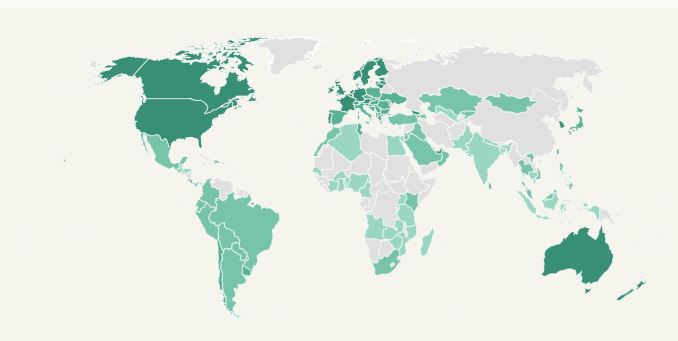
4. The Countries Winning the AI Race Are Already Rich
Anthropic found a striking global pattern:
AI usage is heavily concentrated in wealthy economies.
Countries like:
- Singapore
- Israel
- the United States
- Canada
- Switzerland
- Australia
massively over-index in AI adoption. Poorer countries lag far behind.
Historically, technology eventually spreads globally. But the early phases tend to reward countries with:
- capital,
- infrastructure,
- education,
- strong digital industries.
AI appears to be accelerating this dynamic.
The danger isn’t just inequality inside countries.
It’s inequality between countries.
The same technology that promises democratized intelligence may initially deepen global economic divides.
5. The Office Is Becoming the Factory
For most of industrial history, factories were where productivity pressure lived.
Now the office is becoming industrialized.
Generative AI is introducing:
- workflow optimization,
- output measurement,
- task compression,
- fewer people producing more work.
The language of modern management increasingly sounds like logistics software:
- efficiency,
- throughput,
- optimization,
- leverage.
And unlike previous software waves, AI doesn’t just organize work.
It performs pieces of it.
The result may be the emergence of the “compressed company”:
smaller teams, fewer juniors, more automation, higher expectations.
Not necessarily because executives are evil.
Because competition rewards efficiency.
Every company that successfully replaces 20 workers with five AI-assisted employees pressures competitors to follow.
That dynamic compounds quickly.
6. AI Might Reshape Society Without Causing Mass Unemployment
This may be the report’s deepest implication.
The public debate assumes the danger is sudden unemployment spikes.
But AI may transform society through something more gradual:
- weaker bargaining power,
- slower hiring,
- flatter organizations,
- wage pressure,
- fewer promotions,
- reduced entry points into careers.
A generation ago, technology often created new middle-class ladders.
AI may narrow them.
That’s a different kind of disruption:
less cinematic,
more systemic.
A world where jobs technically still exist but fewer people can build stable lives from them.
7. The Most Valuable Skill of the Next Decade May Be Judgment
If AI can generate code, text, research, images, and analysis in seconds, what becomes scarce?
Not information.
Judgment.
The people who thrive may not be those who compete against AI.
They may be those who become exceptional at:
- deciding what matters,
- verifying truth,
- navigating ambiguity,
- coordinating humans,
- building trust,
- making high-stakes decisions under uncertainty.
In that sense, the AI economy may reward something surprisingly ancient:
wisdom.
Not just technical skill.
Not just productivity.
But the ability to know what should happen next when the machine gives you 1,000 possibilities.
The Real AI Revolution Might Be Boring
That may sound anticlimactic.
No humanoid robot armies.
No overnight collapse.
No Skynet.
Just:
- fewer entry-level jobs,
- smaller teams,
- permanently accelerated work,
- rising expectations,
- widening productivity gaps,
- and a labor market quietly reorganizing itself around AI-native workers.
But historically, the most transformative technologies often arrive this way.
Not with explosions.
With infrastructure.
The industrial revolution wasn’t a single event.
Neither was the internet.
And AI may not announce itself through catastrophe.
It may simply become the invisible operating system underneath modern work until one day we realize the economy has changed shape around us.
Don’t forget to Save for Later