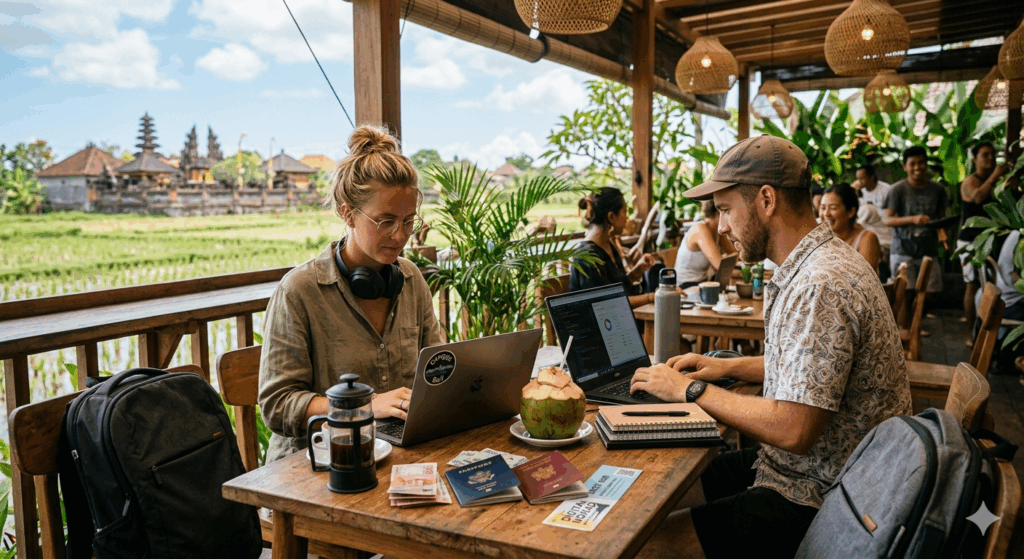
They sit at the same café in Bali, their laptops open to identical dashboards, their coffee orders indistinguishable. Both are software architects for the same global firm. Both debug the same systems, attend the same virtual meetings, and deliver code that flows seamlessly across borders.
But only one crossed those borders seamlessly.
The first, from Seattle, arrived with little more than a booking confirmation and a passport that opened doors without question. The second, from Lagos, arrived through a labyrinth of embassy appointments, financial disclosures, biometric scans, and the ever-present possibility of rejection. One moves through the world as a global citizen. The other, perpetually, as a visa applicant.
They share a profession. What they do not share is mobility. And in the 21st century, mobility is fast becoming the most decisive form of power.
For much of modern history, inequality was anchored to land: where you were born determined your access to education, healthcare, and economic opportunity. But the rise of remote work promised a rupture in this logic. Freed from the constraints of office and geography, workers could, in theory, transcend the arbitrary limitations of nation-states. The laptop became a passport; the internet, a borderless territory.
This was the mythology of the digital nomad: a figure self-directed, liberated.
Yet the reality emerging from recent data tells a more complicated story. The digital nomad movement, far from dissolving borders, may be reconstituting them along older, more deeply entrenched lines.
Consider the demographics. Roughly 59 per cent of digital nomads identify as White, and 44 per cent are American. These are not incidental figures. The ability to go global or even work remotely is not evenly distributed. It is heavily mediated by nationality and, by extension, by race, history, and geopolitics.
This is the strong passport effect: a quiet but powerful determinant of who gets to participate in the new economy of movement. As well as an essential travel document, your passport is a credential, a proxy for trustworthiness, stability, and economic desirability. Some passports function as skeleton keys. Others, as barriers.
At first glance, the proliferation of digital nomad visas appears to signal a democratization of mobility. Nations from Estonia to Costa Rica now invite remote workers to reside temporarily within their borders, offering streamlined applications and tax incentives. The language is one of openness, flexibility, and mutual benefit.
But beneath this rhetoric lies a subtler calculus.
These visas are not universally accessible. They typically require proof of substantial income, stable employment, and, crucially, citizenship from countries deemed low risk. The criteria are framed in economic terms, yet they map closely onto existing global hierarchies. A remote worker from Berlin or San Francisco is welcomed as an asset. One from other areas may struggle to meet the same thresholds, or face additional scrutiny even when they do.
What emerges is a tiered world of work. In this sense, digital nomad visas do not so much dismantle borders as reconfigure them. They shift the basis of inclusion from territorial belonging to economic utility. You are not admitted because you are a citizen, but because you are valuable.
This marks a profound transformation in the relationship between individual and state.
Traditionally, rights were tethered to soil. Citizenship conferred a bundle of entitlements, political participation, legal protection, social services, within a defined territory. Movement across borders required negotiation between states, mediated through visas, treaties, and diplomacy.
The digital nomad disrupts this arrangement. She is not fully embedded in any one polity, nor entirely excluded from others. Instead, she occupies a liminal space: a temporary resident whose presence is justified not by belonging, but by contribution.
This does loosen the old world values of rigid ties between identity and geography. But it also introduces a new form of precarity. If your right to reside somewhere depends on your economic value, what happens when that value fluctuates? When your contract ends, your income dips, or your industry shifts?
Mobility, in this framework, is conditional. It is granted, not guaranteed.
The deeper question, then, is whether the digital nomad movement represents a genuine escape from the constraints of the nation-state, or simply the latest iteration of an older pattern: the uneven distribution of freedom.
There are echoes here of colonial-era privilege, when movement was similarly stratified along lines of origin and power. Then, as now, some individuals could traverse vast distances with ease, while others were confined by invisible but rigid boundaries.
The difference is that today’s hierarchies are less overt, more bureaucratically encoded. They are embedded in visa policies, income thresholds, and risk assessments. They operate not through explicit exclusion, but through selective inclusion.
And they are justified not in terms of empire, but of efficiency.
The ability to work globally does not automatically translate into the ability to live globally. And it is in this gapbetween economic participation and physical mobility that a new form of inequality is taking shape.
We might call it a mobility aristocracy: a class defined not by inherited wealth alone, but by the accident of birthplace. Its members are those whose passports grant them frictionless movement, whose identities align with the expectations of host nations, and whose economic profiles render them desirable.
Back in the Bali café, the two architects continue their work. Their screens glow with the same code; their conversations drift across the same Slack channels. From a distance, they appear interchangeable.
But one can decide, on a whim, to move to Lisbon next month, or Tokyo, or Buenos Aires. The other must plan months in advance, navigate uncertain processes, and accept that the answer may still be no.
In a world increasingly defined by movement, this difference is not trivial. It is foundational.
The question how these borders are being rewritten and for whom?
The café remains the same. The code compiles. The coffee cools. Only the freedom to leave and to arrive sets them apart.