
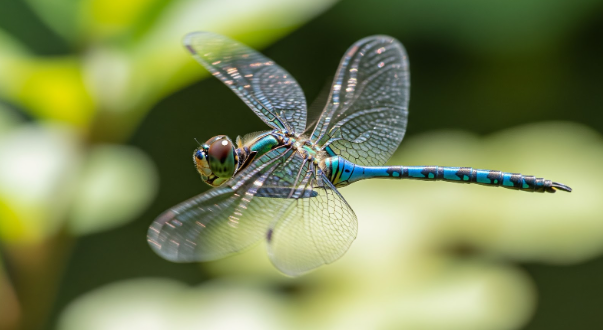
What can humand learn from the oldest masters of focus? Let’s take a close look at the attributes of a dragon fly that make us envious. Three hundred million years before our first tools, dragonflies perfected the arts of attention, agility, and transformation. Perhaps their ancient grace can still teach us how to move, think, and live.
The Dragonfly Doctrine
By the time humans appeared on Earth, dragonflies had already been flying for nearly 300 million years.
They hunted through prehistoric swamps when ferns were forests and amphibians ruled the land. Their ancestors once spanned the sky with wingspans nearly the size of a hawk’s. Today they are smaller, sleeker.
The modern dragonfly is not just a survivor but an apex exemplar of focus, economy, and adaptation.
Perhaps it is time we started learning from them.
The Art of Singular Attention
Watch a dragonfly in flight and you’ll see what undistracted purpose looks like. A single individual can track one mosquito among a thousand locking onto its target and adjusting course through the air with astonishing accuracy. Neuroscientists studying these insects have discovered that their brains are capable of target-selective attention, a form of focus once thought to belong only to primates. When a dragonfly commits to a chase, it succeeds over 95 percent of the time.
“The dragonfly doesn’t multitask. It chooses, commits, and acts. The rest of the world blurs away.”
In an age where human attention is fractured between notifications and noise, the dragonfly’s single-mindedness feels almost spiritual.
Vision Without Overwhelm
Each dragonfly eye contains roughly 30,000 ommatidia (tiny lenses) that give it nearly 360 degrees of vision.
It perceives more colors than we can imagine, including ultraviolet and polarized light, yet its brain never stalls from too much input. Instead, it filters and prioritizes, processing only what matters most to the hunt.
Humans, by contrast, drown daily in data. Our challenge is not to see more, but to extract meaning from abundance and start saving for later. The dragonfly’s lesson here is subtle: awareness need not lead to overload. The key lies in discerning focus, not constant vigilance.
Grace Through Simplicity
The dragonfly’s agility seems miraculous, but its mechanism is minimalist.
Four wings, each moving independently, create complex patterns of lift and drag.
This simple structure allows it to hover, reverse, or dart forward at 30 miles per hour, turning on a dime to pursue prey or evade a threat.
Dragonflies are among the most agile fliers in the insect world, capable of flying forward, backward, sideways, hovering in place, and making instantaneous turns. They can control each of their four wings independently, enabling complex flight maneuvers such as free-gliding, pivoting on a spot, and even flying upside down for brief moments.
Their motion is an essay in control. Humans, by contrast, often try to muscle their way through complexity, mistaking effort for effectiveness. The dragonfly’s lesson is one of grace under motion: agility doesn’t come from doing more, but from mastering control over what you already have.
“Flexibility, the ability to shift direction swiftly without losing balance, may be our most overlooked form of intelligence.”
Transformation Without Fear
Before a dragonfly ever takes to the sky, it spends years underwater as a nymph, breathing through gills and hunting in murky ponds. One day, it climbs a reed, sheds its skin, and emerges into the open air, a radical transformation completed within hours. A complete metamorphosis you might say. The creature that once swam now flies.
This metamorphosis is neither hesitant nor uncertain. The dragonfly does not cling to the water once it feels the call of air. Its transformation is total. For humans, too, every reinvention demands a willingness to molt, to leave behind an identity, a routine, a certainty. Growth often looks like loss until we realize we were meant to fly.
The Rhythm of Work and Rest
Even the most efficient hunters pause. Between bursts of flight, dragonflies perch silently, their wings catching the light. They conserve energy, observe, and wait for the right moment to move again.
In our world, stillness is often confused with laziness. Yet nature, in its oldest wisdom, tells another story. Productivity is not a constant hum but a rhythm of focus, release and renewal. The dragonfly’s rest is not idleness; it is calibration.
Old Minds, New Lessons
Dragonflies are not sentimental creatures. They do not romanticize their survival. They simply embody it. In their ancient design lies a blueprint for attention, adaptability, and elegant efficiency, qualities that modern humans, with all our tools, seem to be losing.
Perhaps the dragonfly does not need to evolve much further. Perhaps it already mastered the art of doing just enough, perfectly. For us, the challenge is not to become more like machines but more like dragonflies: alert, poised, and present.
Facts About Dragonflies
- Dragonflies date back over 300 million years, predating dinosaurs.
- They capture 95% of their intended prey, among the highest success rates in nature.
- Their compound eyes provide nearly 360° vision and can detect colors beyond human range, including ultraviolet light.
- Each of their four wings can move separately, allowing them to hover, fly backward, and change direction instantly.
- Dragonflies can fly forward, backward, sideways, hover in place, and perform tight mid-air turns.
- They can reach speeds of 25–30 mph with helicopter-like precision.
- They spend up to five years as aquatic nymphs before transforming into adults that live only a few months.
- Found on every continent except Antarctica, with over 5,000 known species.
- As voracious predators of mosquitoes and flies, they are crucial to maintaining ecological balance.