The Panopticon of the Side Hustle
In 1971, the moderator Fons Elders compared Noam Chomsky and Michel Foucault to mountain diggers working at opposite sides of the same mountain… without knowing if they are working in each other’s direction. Chomsky dug with the tools of linguistics, searching for a solid, human nature, a core of innate creativity that makes us fundamentally free. Foucault, however, was digging to prove the mountain wasn’t there. For him, the mountain of human nature was a pile of social debris, a grid constructed by power to keep the diggers occupied.
Fifty years later, the mountain has collapsed. In the rubble of the modern workplace, we find ourselves in a strange inversion: we are no longer digging for truth or building for progress; we are simply watching one another dig.
The Creativity Trap
Chomsky argued that a child who acquired language… is able to say what he means… in a fashion that I think it’s proper to call highly creative. To Chomsky, work should be the adult extension of this linguistic freedom, uncoerced, self-determined expression. The modern gig economy has taken Chomsky’s creative nature and stripped it of the decentralized system of free associations he deemed necessary.
A prediction: By 2030, creativity will no longer be a trait, but a metric. As AI automates rote production, the creative worker becomes a 24/7 brand. We aren’t being freed to create; we are being compelled to perform authenticity for an algorithm. Without the anarcho-syndicalist control Chomsky demanded, doing what you love becomes a high-speed treadmill of self-exploitation where burnout is the only honest output.
From Production to Surveillance
Foucault’s most chilling contribution to the debate was his refusal to see institutions like schools or workshops as neutral. He argued they are made to maintain in power a certain social class and to “criticize the play of institutions which appear to be the most neutral and independent”.
As we move into a post-production economy, Foucault’s Discipline and Punish becomes our daily reality. Our labor is shifting from the creation of value to the surveillance of it.
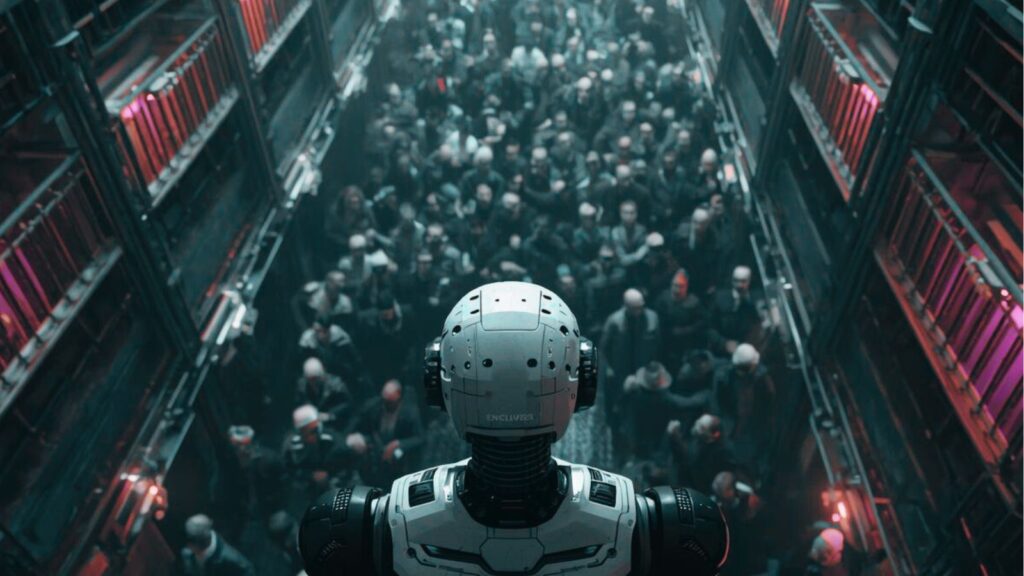
A Prediction: The Rise of the Algorithmic Overseer In the next five years, the Professional-Managerial Class will undergo a major pivot. As generative AI handles the production (writing code, drafting briefs, generating art), human labor will shift almost entirely to policing and moderation.
The War of the Grids
Foucault famously argued that the proletariat makes war “because it wants to take power… and because it wants to take power, it considers its war to be just”.
The future of work is not a quest for a better justice, but a battle over who controls the surveillance apparatus. In the Culture Wars, we see the first skirmishes of this: it is a fight not over what we produce, but over the “grid of rules” that defines who is allowed to speak and work.
Foucault argued that power in the modern age isn’t about a king issuing decrees, but about normalization the subtle pressure to conform to a standard. He noted that:
“The power of the Norm… joins the power of the Law, the School, and the Workshop.” (Discipline and Punish)
By 2026, Gartner predicts that 20% of organizations will use AI to flatten their structures, eliminating up to half of middle-management roles. The Manager who gives instructions is being replaced by the Normalizer, an AI system that doesn’t tell you what to do but nudges your behavior toward a mathematical mean.
You won’t be fired by a person for laziness; you will be de-prioritized by an algorithm for falling outside the standard deviation of optimal engagement.
The Stark Summary
| Feature | Traditional Production (1971) | The Algorithmic Overseer (2026) |
| Tool | The Shovel / The Machine | The LLM / The Sensor |
| Control | Physical Presence (The Clock) | Predictive Analytics (The Vibe) |
| Discipline | Punishment for failure to produce | Normalization of mood and tone |
| The Goal | To build the Mountain | To maintain the Grid |
Don’t forget to Save for Later