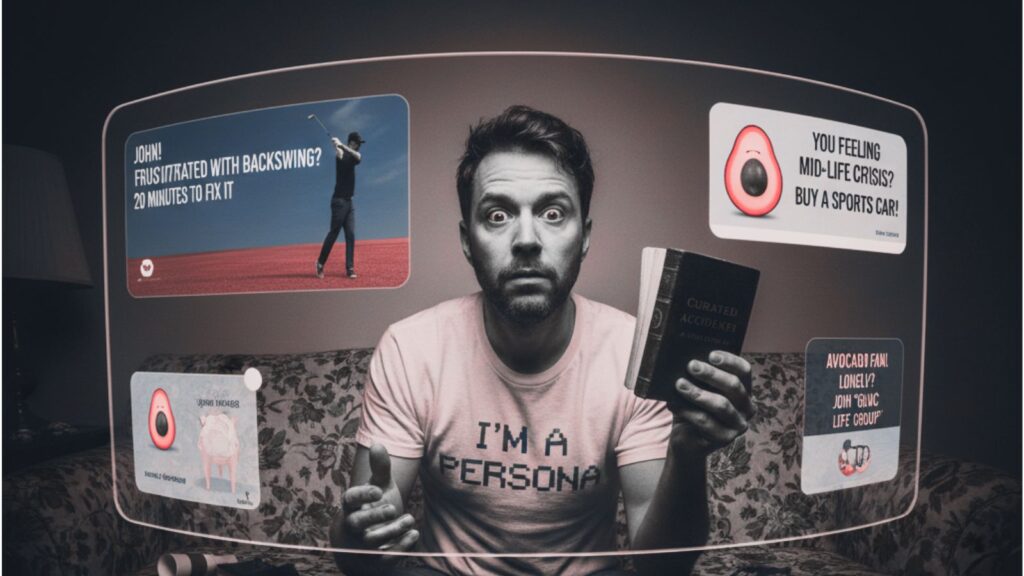
This is the end of what was the term ‘persona’ and used across the board by marketing executives and agencies alike. Traditional marketing targets “Millennial males interested in golf.” AI marketing targets “John, who is currently frustrated with his backswing and has a 20-minute gap in his calendar.”
For decades, the architect of the commercial world was the demographer. They worked in the medium of the average, constructing ghosts out of census data and consumer surveys. We called these ghosts personas. You might recognize them: Millennial Michael, the urban dweller who values authenticity and craft beer; or Suburban Sarah, who prioritizes convenience and family safety. These were the target markets, the broad, blunt instruments used to carve out a space for products in the collective consciousness.
But as we drift deeper into the 2020s, these ghosts are being exorcised. The crude categories of age, gender, and zip code are dissolving into a soup of high-velocity data. In their place, a new, more unsettling entity is emerging: the Individual Reality.
Traditional marketing was an act of categorization; AI marketing is an act of observation. It no longer cares that you are a 34-year-old male interested in golf. It cares that you are John, currently staring at your smartphone in the 20-minute gap between meetings, feeling a distinct, sharp pang of frustration because your backswing felt “off” during Sunday’s round. The “Hyper-Niche” Renaissance is not about smaller groups; it is about the end of the group entirely. We are moving from five buyer personas to 5,000, or 5 million, micro-narratives, each a bespoke mirror held up to our immediate, fleeting emotional states.
The Infinite Mirror
This shift represents a fundamental change in the psychology of the sell. When content is infinite and production costs for a single ad variation drop to near-zero, the target market is replaced by a “real-time feedback loop.
Imagine an algorithm that doesn’t just show you a pair of running shoes because you like fitness. Instead, it generates ten thousand variations of that shoe’s story. For the person feeling a mid-life crisis at 2:00 AM, the ad highlights The Long Road Ahead and the solitude of the dawn run. For the person who just saw their rival’s marathon time on Strava, the ad shifts in real-time to The Edge of Competition.
We are no longer being invited into a brand’s world; the brand is aggressively terraforming itself to fit into ours. The “Persona” was a mask we were expected to wear; the Individual Reality is a surveillance of the face behind it.
The Loss of the “Curated Accident”
As our digital environments become perfectly personalized, we face a philosophical crisis: the death of serendipity. In the pre-algorithmic era, we encountered things by accident. You went to the bookstore for a biography and left with a book on Stoicism because it happened to be on the display table next to the checkout. These were curated accidents – moments where the world offered us something we didn’t know we wanted, forcing us to grow, to pivot, or to see ourselves differently.
When recommendations are perfect, the accident is removed. If the algorithm knows exactly what will satisfy my current emotional state, it will never show me the thing that might change it. We become trapped in a You Loop, a hall of mirrors where every recommendation is a reinforcement of who we were five minutes ago.
Will we, in this age of hyper-relevance, begin to value the unoptimized more than the perfect? Will there be a premium on the messy, the irrelevant, and the unexpected? If a machine can predict my every desire, the only thing truly valuable becomes the thing it didn’t see coming.
The Psychological Pivot
To move from a product description to a micro-narrative, you must stop describing the object and start describing the internal state of the user. Here are five prompts to help you turn a single product into ten different psychological angles:
- The Status-Seeker: “How does owning this product signal that the user has moved from ‘Level A’ to ‘Level B’ in their social hierarchy?”
- The Anxiety-Alleviator: “What specific, hidden fear does this product act as a ‘shield’ against (e.g., the fear of being seen as unprepared)?”
- The Identity-Anchor: “How does this product confirm a belief the user already has about themselves (e.g., ‘I am the kind of person who values deep work’)?”
- The Time-Redeemer: “If the user feels overwhelmed, how does this product promise to ‘buy back’ their most precious resource: mental clarity?”
- The FOMO-Trigger: “What is the ‘insider’ secret that only owners of this product know, and how can we highlight the cost of being on the outside?”
Try and test these prompts and please report your findings. The age of AI is changing the way companies behave, the way users behave and how consumers consume.
Don’t forget to Save for Later