Work and Power without Faces. the Empire That No Longer Needs a Center
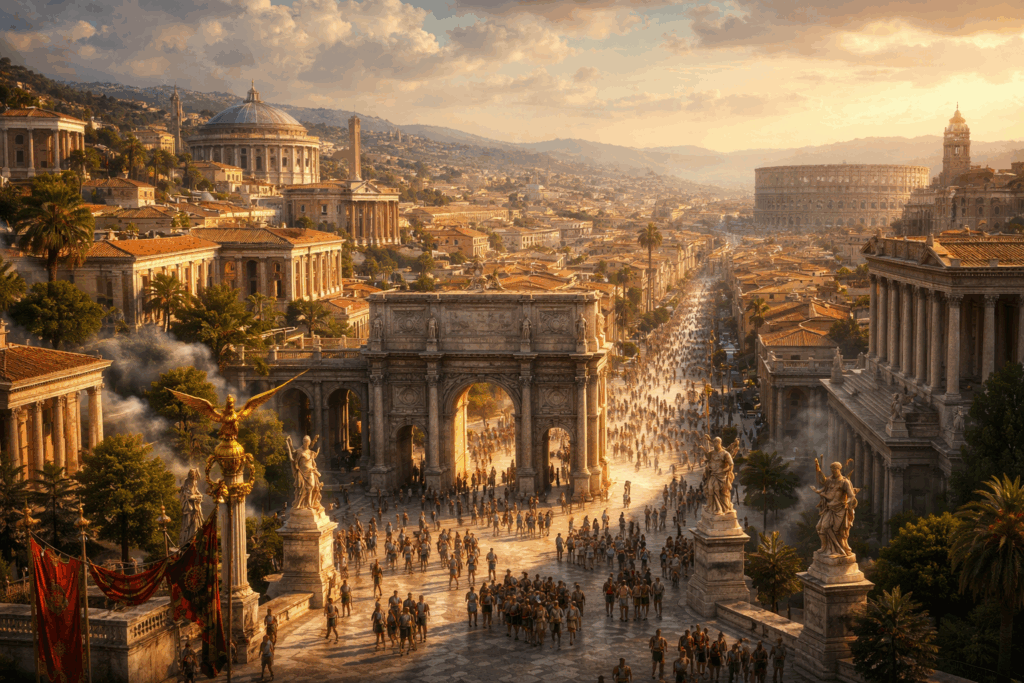
Power is easiest to recognise when it is loud. Armies on the move, laws proclaimed, borders enforced. At the height of the Roman Empire, domination was etched into the landscape itself: roads radiating from the capital, legions marching along them, grain and taxes flowing back in return. Authority was visible, spatial, and unapologetic.
Today, power has become quieter. It no longer needs monuments or marches. It hums in climate-controlled buildings at the edges of cities, pulses through fiber-optic cables beneath the sea, and manifests as metrics, dashboards, and automated decisions. The empire still exists, but it is infrastructural rather than territorial, procedural rather than personal.
Three thinkers, Michel Foucault, Hannah Arendt, and Max Weber, offer a way to understand this transformation. Read together, they reveal not only how modern power operates through work, but why a world organised entirely around efficiency risks becoming politically hollow.
Foucault approached power sideways. He did not ask who ruled, or by what right, but how conduct was shaped long before rule became visible. Power, for him, was not held; it circulated. It resided in routines, classifications, spatial arrangements, and norms. Modern institutions, schools, factories, offices, hospitals, did not merely coordinate activity. They trained bodies and attention, producing subjects who internalised expectations and monitored themselves.
Work was central to this process. Timetables, productivity measures, evaluations, and surveillance transformed labour into a disciplinary technology. The worker learned not simply to perform tasks, but to become legible, predictable, and optimisable. Control no longer required constant supervision; it was absorbed into habit.
This form of power did not forbid. It normalised. It did not crush resistance; it rendered it unintelligible.
Foucault’s insight has only grown more relevant as work migrates into digital systems. Algorithmic management, performance analytics, and platform-mediated labour extend discipline beyond physical workplaces. Evaluation becomes continuous, automated, and opaque. The subject experiences this not as domination, but as self-improvement. Obedience arrives disguised as choice.
The Problems with Distribution of Power
Where Foucault mapped the mechanics of control, Hannah Arendt worried about what such systems do to the human world they organise. Her thinking was shaped not by abstraction but by catastrophe: exile, statelessness, and the bureaucratic machinery of totalitarianism. She was less interested in how power circulates than in what happens when politics disappears.
Arendt distinguished between labour, work, and action. Labour sustains biological life; work builds durable objects and institutions; action, conducted through speech and collective judgment, creates politics itself. Modern societies, she argued, collapse these distinctions. Everything becomes labour, endless activity without permanence or public meaning.
The danger, for Arendt, was not that people would be forced to obey, but that they would stop thinking. Bureaucratic systems encourage compliance without judgment, efficiency without responsibility. Evil, in her most unsettling formulation, does not require fanaticism. It can arise from ordinary people doing their jobs, following procedures, and never asking what their actions make possible.
In a world dominated by work, action becomes a luxury. Politics is reduced to administration; citizenship to participation in systems one does not shape. People remain busy, productive, and connected yet increasingly superfluous.
Max Weber provides the structural link between these two diagnoses. His account of rationalisation describes a world increasingly governed by calculation, predictability, and formal rules. Bureaucracy, for Weber, is not merely an organisational choice but the defining logic of modern power. It replaces personal authority with procedure, judgment with role compliance.
This produces what Weber famously called the “iron cage”: a social order that persists not because it is just or meaningful, but because it is efficient and indispensable. Individuals become functionaries within systems that no one fully controls, yet everyone depends upon.
In the digital age, this cage tightens. Algorithms do not simply administer rules; they optimise them continuously. Decisions once made by humans are delegated to systems trained on historical data, insulated from appeal, and justified as technical necessity. Responsibility dissolves into design choices made elsewhere, by no one in particular.
Taken together, Foucault, Arendt, and Weber illuminate the architecture of a new kind of empire. It does not conquer territory so much as organise dependence. It does not demand loyalty so much as participation. Its power lies not in spectacle, but in infrastructure.
In this empire, citizens become users. Rights become access permissions. Exile becomes de-platforming. Resistance appears not as dissent, but as friction an inefficiency to be corrected. Control is total not because it is violent, but because it works.
The risk is not that such systems will collapse dramatically. It is that they will endure, quietly eroding the conditions for political action and collective judgment. The Roman Empire fell when it could no longer coordinate itself across distance and difference. A digital empire may persist far longer, even as meaning drains away from the lives it organises.
Power, in this form, does not announce itself. It optimises. It manages. It normalises.
The question these thinkers leave us with is not whether such an empire can be resisted, but whether a world structured entirely around work, efficiency, and control can still make room for freedom not as a feature, but as an action.
Empires once left ruins.
This one may leave only uptime.
Empire Without Earth: Essays on Power After Territory
This is the first in a series of essays about the role of the empire and changing power dynamics of today. Classical empire, exemplified by the Roman Empire, was built on land, labor, and legibility. Roads, censuses, law, and force made power visible and enforceable. The emerging empire is quieter. It governs through networks, platforms, protocols, and computation. Its citizens may not know they belong to it.
This series explores what empire becomes when roads turn into cables, fortresses into data centers, and governance into algorithms. Stay tuned for new essays in this series in the new year.