
We often imagine personal growth as a dramatic undertaking: long evenings devoted to study, ambitious online courses, and shelves of books that promise mastery. But the psychology of learning suggests a humbler truth that humans learn best not through heroic bursts of effort, but through small, consistent rituals that shape the contours of attention.
In a culture enamored with acceleration, it feels almost radical to learn slowly.
Yet the slow approach is the one most compatible with the rhythms of adult life. Cognitive load, emotional energy, and the unpredictability of modern work make it nearly impossible to sustain intensive learning for long. What can be sustained, however, is thirty minutes a day.
Thirty minutes is a boundary the mind respects. It is too small to resist, yet large enough to shift one’s identity over time. A daily learning ritual of this length becomes not merely an act of skill acquisition, but a meditation on focus.
Step 1: The Choosing
The first step is not to learn but to choose. This is perhaps the most neglected moment in any learning journey. We are often seduced by fashionable skills but true learning requires alignment with one’s deeper trajectory. The question is not What is valuable? but What will remain meaningful to me a year from now?
Selecting a domain with long-term resonance creates an emotional anchor. Learning becomes less a performance and more an exploration.
Step 2: The Micro-Module
The second step is to reduce ambition to a scale the mind can easily hold. In a thirty-minute session, the module is tiny: one concept, one technique, one small problem. When modules are small, progress is inevitable. When progress is inevitable, motivation becomes effortless.
This gentle forward motion rewires one’s relationship to learning. What once felt like obligation begins to feel like nourishment.
Step 3: The Making
Knowledge, to be retained, must be made concrete. A thirty-minute ritual should always include a brief act of creation. A paragraph summarizing a concept. A few lines of code. A sketch of a design idea. A mind-map of connections.
Creation transforms learning from passive consumption into embodied practice.
Step 4: The Stitching
The most overlooked aspect of learning is integration. At the end of each week, spend one session “stitching together” the fragments: reviewing notes, making connections, identifying themes. Over time, these fragments cohere into a surprisingly rich tapestry of understanding.
Step 5: The Reflection
Every month, ask a single question: How have I changed?
This question draws learning back into the realm of identity. It is the moment where skill becomes self-knowledge.
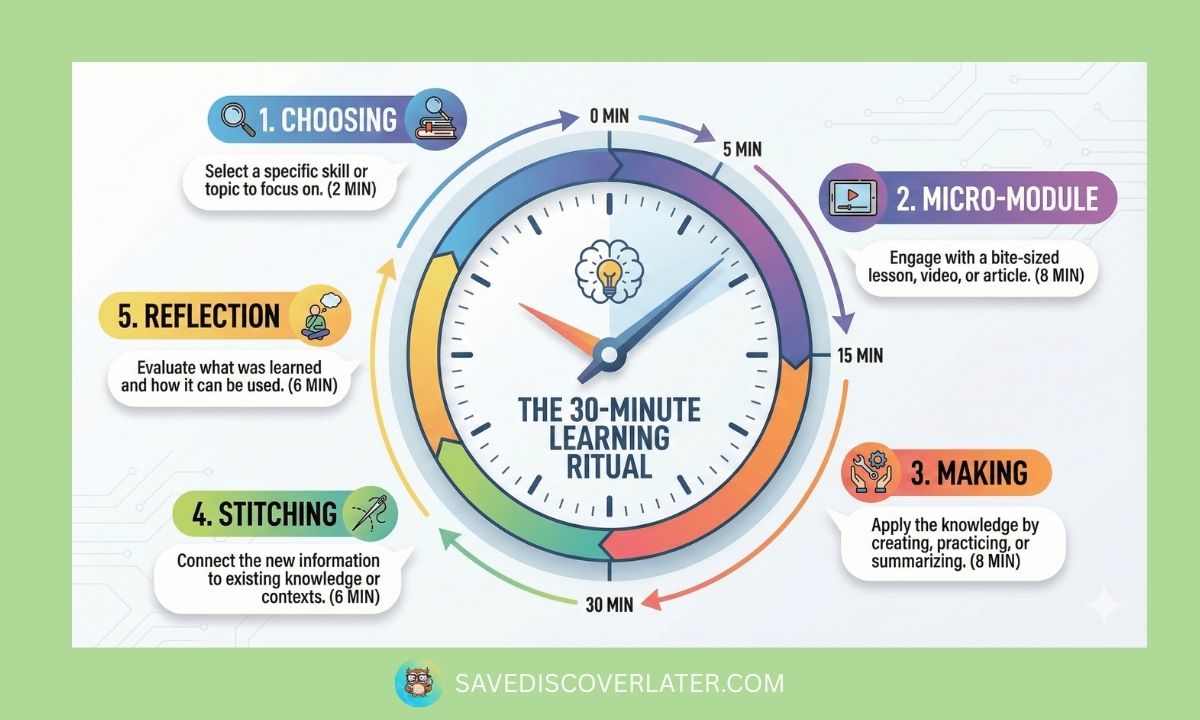
If sustained for a year, a thirty-minute daily ritual amounts to over one hundred fifty hours of focused learnin, the equivalent of a university course completed without pressure, sacrifice, or burnout. The cumulative effect is not just new skill, but a deeper sense of agency over one’s evolving self.
Don’t forget to Save for Later if you don’t have time to digest.