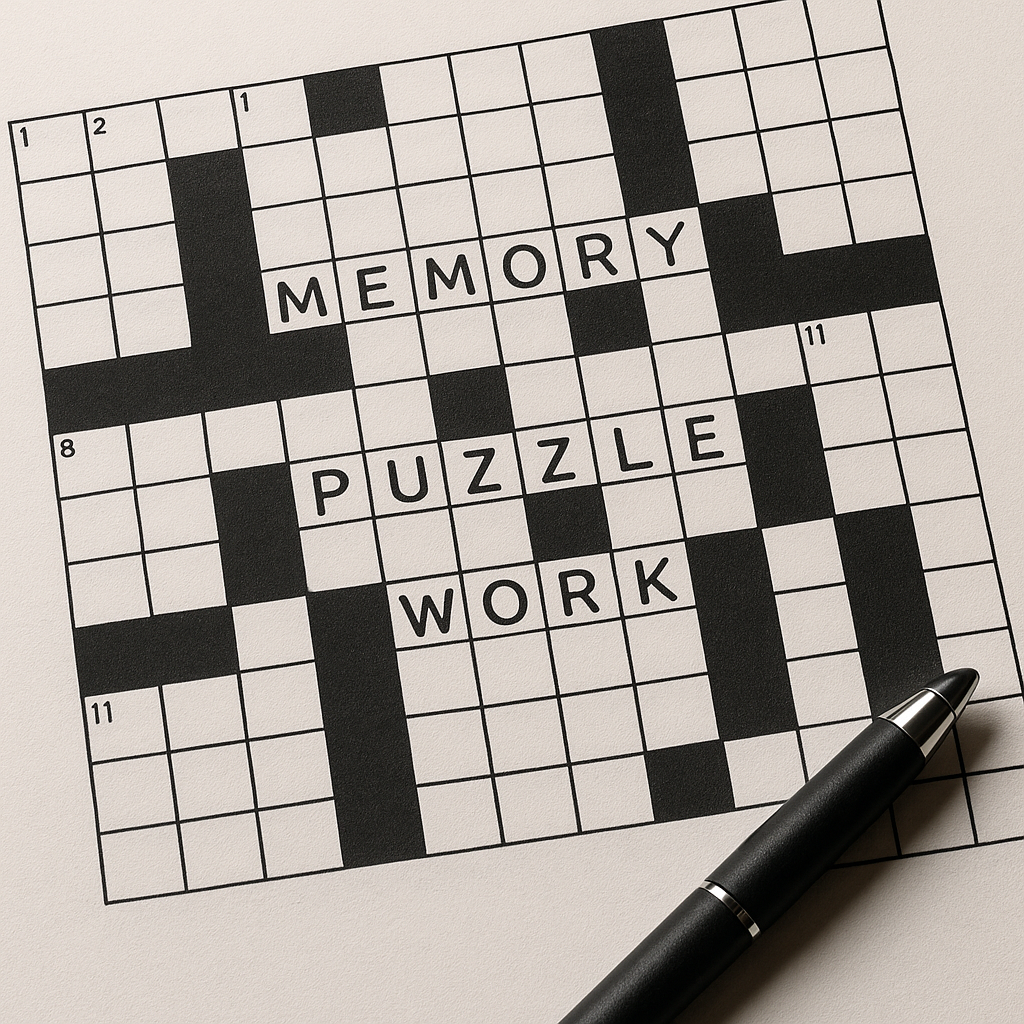
On a grey Sunday morning in Dublin, Miriam O’Dwyer sits with her coffee and opens the weekend’s crossword. At 80 years old, she claims she “wouldn’t be so sharp without it.” It’s a ritual that has accompanied her for decades, a quiet exercise in wordplay that she says helps her to remember things she may have otherwise long forgotten. Research suggests that puzzles are not a trivial pastime, they may actually be a kind of cognitive scaffolding, a daily discipline that preserves memory, bolsters attention, and even protects the structure of the brain.
Recent findings out of Columbia University show that older adults with mild cognitive impairment who practiced online crossword puzzles for 18 months suffered significantly less brain shrinkage than peers assigned generic cognitive games. On memory tests, they outperformed their counterparts. In another trial, weekly crossword training yielded gains of nearly one point on a 70-point cognitive scale within three months. It is a benefit comparable to that produced by some Alzheimer’s medications.
What does this mean for those of us in offices, boardrooms, and open-plan workspaces, struggling not with memory loss but with the fog of meetings, the grind of multitasking, the ceaseless demand to produce?
The Mental Cross-Training We Don’t Notice
Crosswords compel us to think conceptually. Clues demand not only recall of facts but also pattern recognition, metaphorical leaps, and linguistic flexibility. To solve “Capital that’s south of Rome” (answer: EURO), one must toggle between geography, currency, and wordplay. This act of mental shape-shifting resembles the kind of cognitive agility professionals need to find lateral solutions, and connect disparate ideas in negotiations or strategy sessions.
In workplaces increasingly dominated AI, this agility is no small thing. As tasks migrate to machines, what remains most valuable is the human capacity to pivot, to see patterns machines miss, to imagine alternatives. Puzzles are a low-stakes rehearsal.
Protecting Careers for Future Roles
Professional life is longer than ever. Many of us will work into our 60s, 70s, and beyond. That makes cognitive durability an economic necessity. The fact that crossword practice was shown to preserve hippocampal volume in older adults should resonate not only with neuroscientists but with anyone concerned about career longevity. A sharp memory isn’t merely an academic luxury; it is the backbone of mentoring, leadership, and trust. When colleagues sense your recall falter, the erosion isn’t only personal, it is professional.
Beyond the Puzzle
There is some level of caution needed here. Decades of research on “brain training” reveal a sobering truth: improvement on the trained task rarely transfers far beyond it. Get better at Sudoku, and you get better at Sudoku. The brilliance of crosswords lies not in some magical general effect, but in their demand for variety, history, science, slang, puns, geography.
To maximize that benefit, neuroscientists recommend mixing puzzle practice with other forms of learning. art, music, languages, even physical exploration such as geocaching or dance. In professional terms: don’t confuse narrow efficiency for genuine growth. The brain, like any good employee, thrives on novelty and challenge.
The Professional Case for Play
So why should professionals care about 15 minutes of wordplay? Because puzzles offer a paradox: the playful can be profoundly serious. Just as a runner knows the value of cross-training in yoga or cycling, the knowledge worker may need mental cross-training in low-stakes, pleasurable tasks.
Miriam O’Dwyers morning puzzle may look like leisure, but in truth, it is a daily act of preparation. For the lawyer navigating contradictory precedents, the consultant weaving disparate data into a strategy, or the mid-career professional warding off burnout, puzzles remind us that the brain, like any muscle, demands practice.
Not every clue will land, and not every meeting will end in clarity. But those who train themselves to tolerate ambiguity, to wrestle with language, to persist in play, may find they are also training themselves for the long game of work.
The puzzle, in other words, is not about the answer. It is about the mind that emerges from the attempt.