Freelancing at the Edge of the Arctic
At 78 degrees north, just 650 miles from the North Pole, the Arctic archipelago of Svalbard is known for its polar bears, frozen tundra, and perpetual twilight. What it’s not known for is being a new hotspot for remote tech workers and freelancers seeking their next great escape.
But things are changing. Workers are leaving the cityscapes to seek solace in remote destinations like Svalbard and others. Any why not? The beauty of remote first is flexibility.
Remote Work Rewriting the Map
Once upon a time, work meant geography: you lived where the jobs were. But in the post-pandemic world, work is increasingly placeless. Connectivity is the new commute. The cloud is the new office. For a growing number of freelancers, consultants, engineers, and creatives, the question is no longer “Where can I work?” but rather, “Where do I want to be while I work?”
And for a small, adventurous group, the answer is Svalbard. We did our research and it turns out the Svalbards snowy peaks and speedy internet connection are top attractions.
Svalbard’s main settlement, Longyearbyen, is a surreal blend of science station, Norwegian outpost, and Instagram daydream. Pastel-colored houses sit beneath snowy cliffs. Snowmobiles outnumber cars. In winter, the sun disappears for months.
And yet, it has some of the fastest internet in the world.
Thanks to undersea fiber-optic cables, originally laid to support satellite monitoring, Svalbard boasts a bandwidth that rivals major cities. Add in visa-free residency for over 40 nationalities, zero income tax, and surprisingly decent coffee, and it starts to make sense why a small but growing number of remote workers are making the icy leap.
Profiles from the Permafrost
“I came here for the silence,” says Emilie, a UX designer from Berlin who now works from a shared coworking lounge nestled between a glacier and a pub that serves reindeer burgers. “I was burnt out. The idea of being somewhere so… stark, so disconnected, was strangely comforting.”
She’s not alone. A Portuguese data analyst named Rui came for the tax benefits. An Australian podcast producer fell in love with the landscape after watching a BBC documentary and arrived on a whim. One American blockchain consultant admits he’s hiding from burnout and Los Angeles traffic in equal measure.
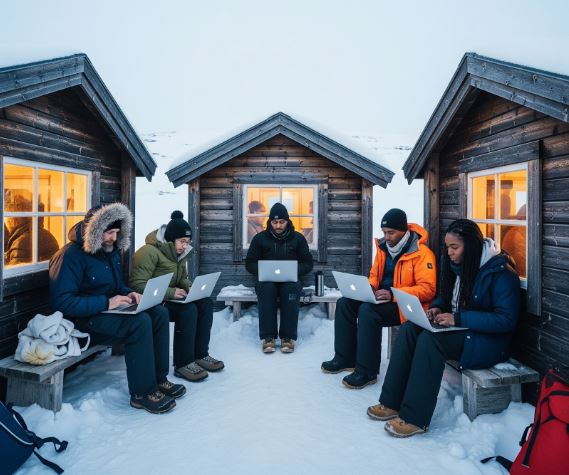
There’s no “scene” here, no WeWork. Just a quiet camaraderie among laptop-lit faces who gather once a week for Arctic-themed trivia night and trade Slack invites over spiced mulled wine.
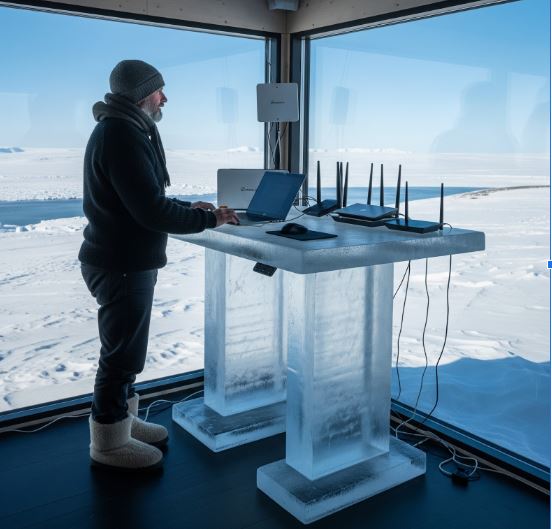
“Coworking in Svalbard is less about networking and more about not freezing,” says Henrik, a Swedish backend developer who hand-built a standing desk from driftwood and snowmobile parts.
Challenges, Hacks & Hacksaws
Living on the edge of the Arctic isn’t all auroras and minimalism.
- Polar night brings months of darkness. Headlamps are standard indoor wear.
- Grocery flights are weather-dependent. No plane = no produce.
- Polar bear patrol is a real thing. Some remote workers take shifts.
But with routine comes innovation. Many digital nomads adopt radical time-blocking techniques to stay focused during the sunless months. Light therapy, cold plunges and deep work cycles are the norm.
Most surprisingly, productivity soars.
“No distractions,” says Emilie. “I went from working eight scattered hours in the city to four hours of deep, focused flow here. Then I go dogsledding.”
Why Svalbard? Why Now?
There’s a deeper trend here. Svalbard represents a symbolic inversion: instead of chasing opportunity to the center, some freelancers are fleeing to the edge.
Some come for:
- Tax incentives
- Environmental inspiration
- Geopolitical neutrality
- Creative solitude
- A need to feel somewhere in a life increasingly lived online
Others come because they feel the climate changing, both literally and metaphorically.
The Rise of “Edge-Working”
From Svalbard to Patagonia, from floating coworking spaces in Bali to underground crypto bunkers in Iceland, the “edge-worker” is a new category of professional. Part nomad, part futurist, part global citizen.
Their work is in the cloud, but their footprint is increasingly at the fringes.
The digital nomads of Svalbard are carving out a philosophy of work that prizes silence, sovereignty, and slowness in an era defined by noise, surveillance, and speed.
In doing so, they are quietly asking a powerful question: If we can work from anywhere… why not work from somewhere unforgettable?